
"Why don't we just hire someone?"
It's a reasonable question. You're evaluating agency retainers in the $10,000 to $20,000 per month range, and you're doing the math. That's $120K to $240K a year. Couldn't you just hire a marketing person for that?
Here's the problem with that logic: you're not comparing equivalent things.
A single marketing hire, no matter how talented, cannot replicate what a full-service agency delivers. You're not choosing between "one person" and "an agency." You're choosing between building a marketing team and accessing a team that already exists.
That's a fundamentally different decision. And once you frame it correctly, the right answer for your firm becomes much clearer.
At GK3 Capital, we've helped asset managers navigate this decision for years. Some have built internal teams. Some have partnered with us. Many have done both. In this article, we'll break down the real costs, the trade-offs, and a framework to help you decide what's right for your situation.
The False Equivalency: Why "Hiring Someone" Doesn't Solve the Problem
When most distribution leaders think about building marketing capability, they picture hiring a marketing director or manager. Someone smart who "gets digital" and can run the show.
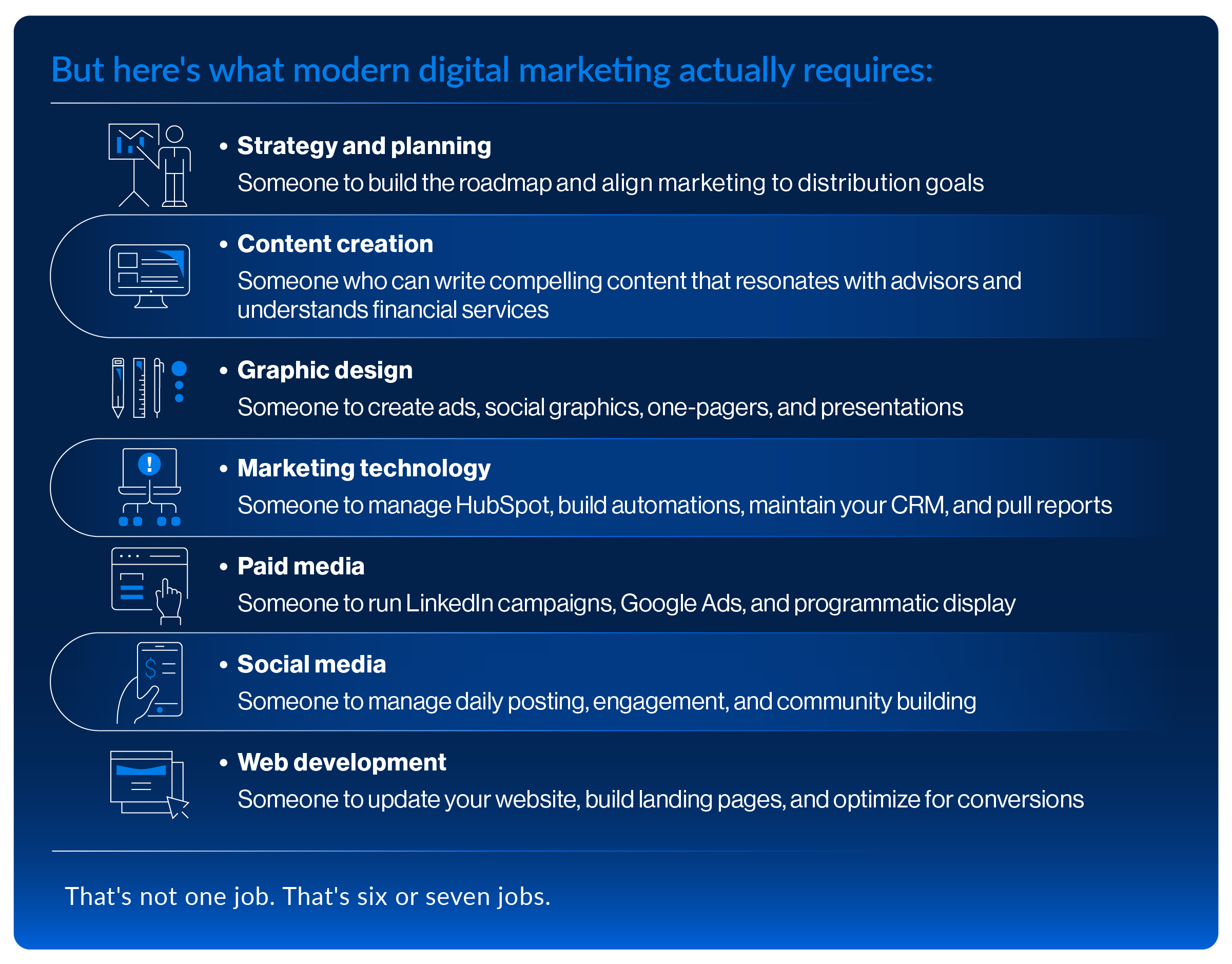
When you hire one marketing person and ask them to do all of this, one of two things happens.
First, they become a coordinator, not an executor. They spend their time managing freelancers and vendors, not actually doing the work. You've added a layer of management without adding capability.
Second, they try to do it all and burn out. Or they do a mediocre job across the board because no one can be a specialist in everything.
Neither outcome grows AUM.
What It Actually Costs to Build a Marketing Team
If you want to build internal capability that matches what a quality agency provides, you need multiple specialists. Here's what that looks like:
|
Role |
Estimated Annual Cost (Fully Loaded) |
|
Marketing Director/Strategist |
$130,000 - $160,000 |
|
Content Writer (Financial Services) |
$90,000 - $120,000 |
|
Social Media Manager |
$70,000 - $90,000 |
|
Graphic Designer |
$80,000 - $100,000 |
|
Web Developer |
$100,000 - $130,000 |
|
Marketing Ops / HubSpot Admin |
$90,000 - $110,000 |
|
Subtotal (salaries + benefits) |
$560,000 - $710,000 |
|
Tools, software, subscriptions |
$50,000 - $75,000 |
|
Management overhead |
$100,000 - $150,000 |
|
Total Annual Cost |
$710,000 - $935,000 |
Call it $800,000 to $1 million annually to build a team that can execute at the level a full-service agency does.
And that assumes you can find the right people. Marketing talent that understands both modern digital execution and financial services is genuinely rare. Recruiting alone can take three to six months per role, and there's always the risk of turnover starting the cycle over.
What Agency Partnership Actually Costs
For comparison, here's what a full-service agency retainer typically costs for asset managers:
|
Engagement Level |
Monthly Investment |
Annual Investment |
|
Foundation |
$8,000 - $10,000 |
$96,000 - $120,000 |
|
Growth |
~$15,000 |
~$180,000 |
|
Enterprise |
$20,000 - $50,000+ |
$240,000 - $600,000+ |
Add $12,000 to $36,000 annually for your marketing platform (HubSpot or similar), and you're looking at $110,000 to $640,000 per year all-in, depending on scope.
Even at the Enterprise level, you're typically paying a fraction of what it would cost to build equivalent capability internally.
Head-to-Head: Building a Team vs. Partnering with an Agency
|
Factor |
Build In-House Team |
Partner with Agency |
|
Annual cost |
$800,000 - $1,000,000+ |
$110,000 - $640,000 |
|
Time to full productivity |
12-18 months |
Immediate |
|
Breadth of expertise |
Limited to hires |
Full team of specialists |
|
Flexibility |
Low (fixed headcount) |
High (adjust scope as needed) |
|
Financial services expertise |
Must recruit or train |
Built-in (with specialized agency) |
|
Management burden |
High |
Low |
|
Long-term strategic asset |
Yes (if team stays) |
No (expertise leaves with agency) |
|
Risk of turnover |
Significant |
Agency's problem, not yours |
|
Cultural integration |
High |
Lower |
Neither option is universally better. The right choice depends on your budget, timeline, and strategic priorities.
The Hybrid Model: Often the Best Answer
Here's what we've seen work exceptionally well: a small internal team paired with agency execution.
The right mix depends on your budget.
$250K to $500K annually: One senior internal hire (Director or VP of Marketing) who owns strategy, manages stakeholders, and coordinates with your distribution team. The agency handles execution across content, design, paid media, and marketing technology.
$500K to $750K annually: Two internal hires, typically a Director of Marketing plus a Marketing Associate or Coordinator, paired with agency execution. The internal team handles strategy, approvals, and internal coordination while the agency provides specialist firepower.
One of our most successful partnerships follows this model exactly.
Client's internal team (2 people):
- Director of Marketing, who owns strategy, manages internal stakeholders, and coordinates with sales leadership
- Marketing Associate, who handles day-to-day coordination, internal communications, and content approvals
GK3 team (6 specialists):
- Account Strategist
- Account Manager
- Media Specialist
- Social Media Specialist
- Content Writer
- Designer
Combined: 8 people running omnichannel campaigns across multiple products and channels.
The Director of Marketing couldn't execute what those six specialists do. And wouldn't want to. But those six specialists couldn't be nearly as effective without the Director driving internal alignment, managing stakeholder expectations, and ensuring brand consistency.
The internal team makes the agency partnership better, not redundant.
This hybrid model gives you:
- Strategic ownership. Someone internal who lives and breathes your firm's priorities.
- Execution firepower. Specialists who do the work without you managing them.
- Flexibility. Scale agency scope up or down without changing headcount.
- Institutional knowledge. The internal team ensures continuity even if agency relationships change.
If you're thinking "I'll just hire one person," consider this: that one person might be most valuable as the connector between your firm and an execution partner, not as a one-person marketing department.
When Building a Full Internal Team Is the Right Call
Let's be direct: building a complete internal marketing team only makes sense at the top end of the budget spectrum. We're talking $750,000 to $1 million or more annually.
At that level, you can afford to hire the four to six specialists needed to cover strategy, content, design, technology, paid media, and analytics. Below that threshold, you're either hiring generalists who can't go deep in any discipline, or you're leaving critical functions uncovered.
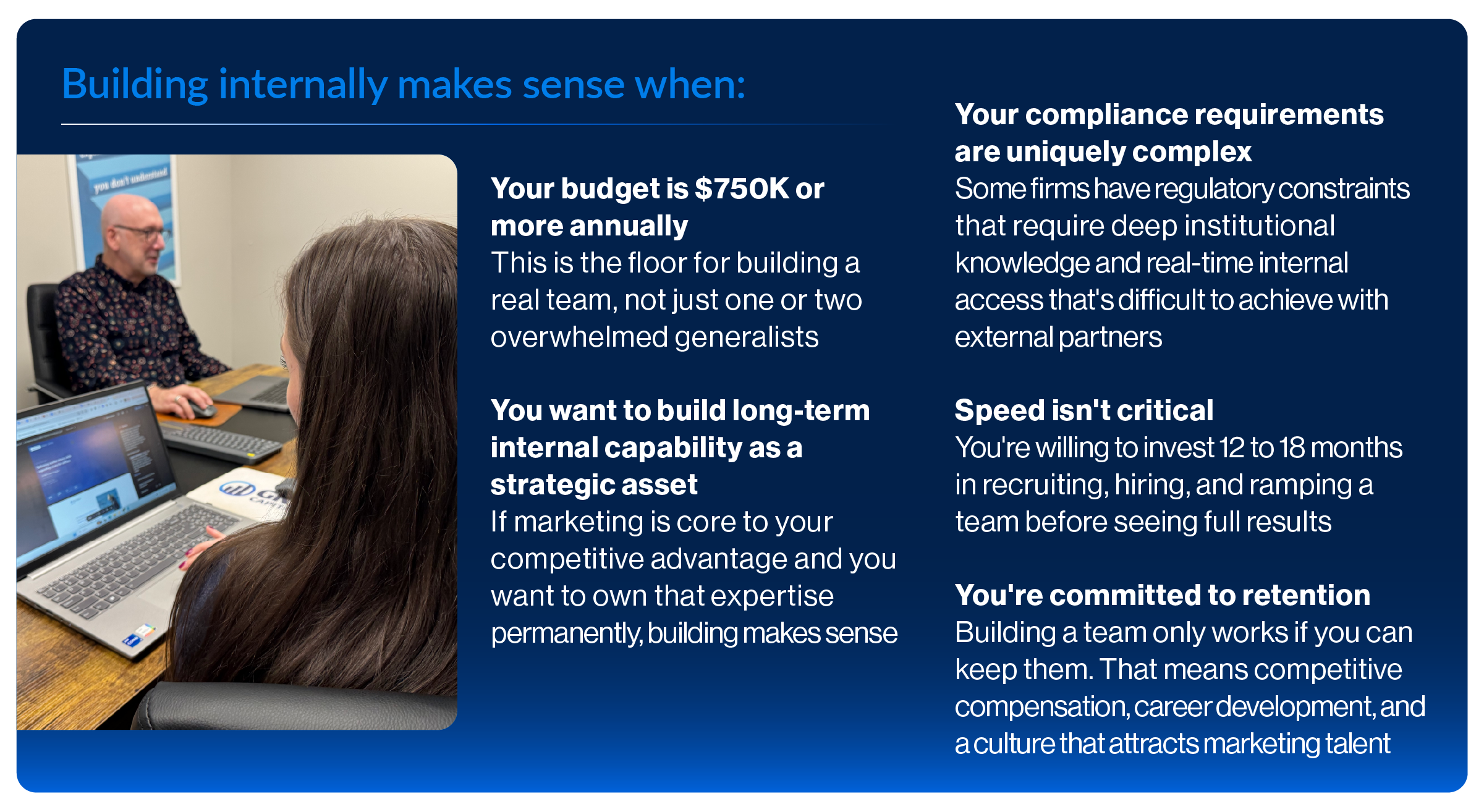
Even at this budget level, many firms still use agencies for specialized functions like media buying, HubSpot administration, or specific campaigns rather than trying to cover everything internally. You're not choosing "all in-house" or "all agency." You're choosing where to build depth internally and where to access specialized help.
When Full Outsourcing Is the Right Call
If your marketing budget is under $250,000 annually, outsourcing completely is almost certainly the right answer.
Here's why: $250K isn't enough to hire even two quality marketing people once you factor in salary, benefits, tools, and management overhead. But it's more than enough for a solid agency retainer that gives you access to an entire team of specialists.
Full outsourcing makes sense when:
- Your budget is under $250K annually. A Growth-level agency retainer (around $180K per year, including platform costs) gets you a full team. That same budget internally gets you one person trying to do six jobs.
- You need execution capacity now. You can't wait 12 or more months to hire and ramp a team. An agency is productive immediately.
- You value specialized financial services expertise. A specialized agency skips the learning curve. They already know your audience, your compliance constraints, and what works in this industry.
- You don't want to manage a marketing department. Leading a distribution team is a full-time job. Adding marketing management to your plate may not be realistic or the best use of your time.
- You want flexibility. Agency engagements can scale up for product launches or scale down during quieter periods. Headcount is fixed.
For most asset managers, this is the reality: budgets under $500K, a need for specialized expertise, and leadership teams that don't have the bandwidth to manage marketers. That's not a limitation. It's a signal that outsourcing is the right model.
The Budget-Based Decision Framework
Forget the abstract questions about "strategic priorities" and "appetite for management." The clearest decision factor is budget.
|
Annual Marketing Budget |
Recommended Model |
What That Looks Like |
|
Under $250K |
Outsource completely |
Full-service agency retainer handles strategy and execution |
|
$250K - $500K |
1 internal + outsource |
Senior hire (Director/VP) owns strategy; agency executes |
|
$500K - $750K |
2 internal + outsource |
Director + Associate/Coordinator; agency provides specialist execution |
|
$750K - $1M+ |
Build internal team |
Full internal team; agency for specialized needs (media buying, specific campaigns) |
Why budget is the deciding factor:
At each threshold, the math changes. Under $250K, you simply can't afford the team needed to execute modern digital marketing internally, but you can afford a quality agency. Between $250K and $750K, you can afford one or two internal people, but not the full bench of specialists, so the hybrid model makes sense. Above $750K, you have real options to build internally.
Most asset managers we talk to are in the under-$500K range. That's not a problem to solve. It's clarity about which model will actually work.
Frequently Asked Questions
Can I start with an agency and eventually bring things in-house?
Yes, and it's a common path. Many firms start with full outsourcing when budgets are under $250K, then add an internal marketing director as budgets grow into the $250K to $500K range. The agency can help you build systems, document processes, and even help recruit your first internal hire. Just be clear about this intention upfront so your agency can help you build toward the right hybrid model rather than creating dependency.
What if I already have one marketing person?
That person might be your secret weapon, not as a replacement for agency execution, but as the internal owner who makes the partnership work. They can manage approvals, coordinate with your distribution team, and ensure the agency's work aligns with your firm's priorities. If your budget supports it ($250K or more), this is exactly the hybrid model that works best. Don't think of it as either/or.
How do I evaluate whether an agency is worth the investment?
The math is simple. If your average new advisor relationship represents $10 million in AUM potential, and your fee generates $50,000 to $100,000 annually on that AUM, a $180,000 per year marketing investment needs to source two to four new meaningful relationships to break even. Everything beyond that is profit. For context, a single external wholesaler costs $250,000 to $400,000 annually, and traditional wholesaling is becoming less effective as advisors research online before taking meetings.
What's the minimum I should spend on marketing?
If you're serious about digital marketing generating pipeline, budget at least $8,000 to $10,000 per month for agency support. That's roughly $100K to $120K annually. Below that, you're likely to get fragmented efforts that don't compound into results. The sweet spot for most asset managers is the $150K to $250K range, which gets you a Growth-level engagement with meaningful scope. See our detailed pricing breakdown for specifics.
What about using freelancers instead of an agency?
You can, but you become the project manager. Coordinating multiple freelancers, making sure the designer talks to the writer, the writer understands the strategy, the ads person has the right assets, is a job in itself. Agencies handle that coordination internally. If you go the freelancer route, you'll need someone (internal or a fractional marketing director) to manage them. At that point, you're often spending similar money with more hassle.
Making the Right Decision for Your Firm
The in-house vs. agency question isn't really about philosophy or preference. It's about math.
Under $250K? Outsource completely. Between $250K and $750K? Build a small internal team and outsource execution. Above $750K? You have real options to build a full internal team, potentially using an agency only for specialized needs.
Most asset managers fall into the first two categories. That's not a constraint. It's clarity. You now know which model will actually work for your situation.
Whatever path you choose, the key is avoiding the false equivalency that started this conversation. "Hiring someone" doesn't replace an agency. You're either building a team or accessing one. Once you're clear on that, the decision gets much simpler.
If you're leaning toward agency partnership or the hybrid model, our Services Catalog breaks down exactly what's included at each engagement level with transparent pricing, so you can make a direct comparison to your internal options.

Topics:
.png?width=650&height=364&name=325x182%20Learning%20Center@2x%20(32).png)


.png?width=400&height=444&name=200x222%20Blog%20Feature%20Image@2x%20(1).png)
.png?width=400&height=444&name=200x222%20Blog%20Feature%20Image@2x%20(10).png)
.png?width=400&height=444&name=200x222%20Blog%20Feature%20Image@2x%20(9).png)
.png?width=400&height=444&name=200x222%20Blog%20Feature%20Image@2x%20(8).png)