

I have a lot of conversations with financial services firms about their pipeline. And one pattern comes up more than any other: the firms that are struggling to grow consistently aren’t struggling because their product is weak or their team isn’t working hard enough. They’re struggling because they don’t have a system behind their growth.
Most of them think about lead generation the same way they think about a gym membership. Nice to have. Something to get to eventually. Not urgent enough to prioritize over everything else already on the plate.
And when deals keep closing through referrals and the wholesalers are busy, it’s easy to convince yourself the status quo is fine.
It isn’t. But the cost of that gap probably isn’t what you think it is.
Yes, you’re missing deals. But that’s almost the least of it. The real cost shows up in your payroll, your marketing budget, your competitive positioning, and your firm’s ability to grow predictably five years from now. It compounds quietly, month after month, until one day the referral network slows down and there’s nothing behind it.
Here’s what that actually looks like.
“We’re a Regulated Industry. Lead Gen Doesn’t Apply to Us.”
This is the most common pushback I hear, and it deserves a direct response.
Whether you’re managing a fund that targets accredited investors, a wholesaling team calling on RIAs, an asset manager distributing through a broker-dealer selling group, or a fintech firm selling into compliance departments, the hesitation is the same: our structure is too complex, our compliance requirements too strict, our audience too sophisticated for a traditional lead gen approach.
That’s not quite right. What’s true is that your lead gen system looks different than a consumer brand’s. The channels, the content, the compliance review process, all of it gets calibrated for a regulated environment. But the core function is identical: creating a predictable, repeatable way to generate interest, stay top of mind, and move qualified prospects toward a conversation.
A wholesaler who shows up in an advisor’s inbox with genuinely useful content before making a call is doing lead gen. An asset manager whose website answers the questions advisors are actually researching is doing lead gen. A fintech firm that publishes comparison content showing up when compliance officers search for solutions is doing lead gen.
The question isn’t whether lead gen works in your structure. It’s whether you’re doing it deliberately or leaving it to chance.
Hidden Cost #1: Your Most Expensive People Are Doing the Least Efficient Work
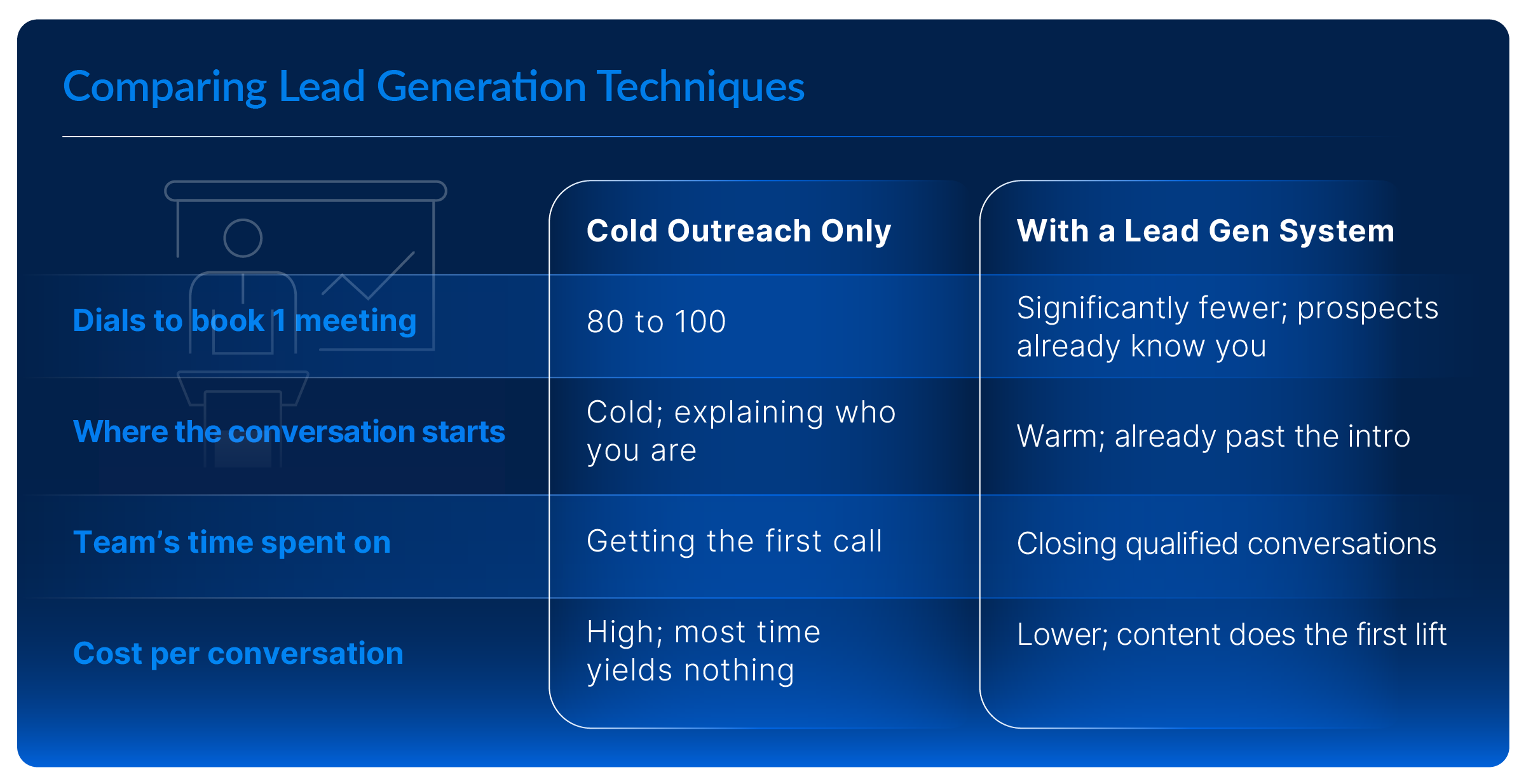
Cold outreach in financial services doesn’t work the way it used to. Wholesalers make 80 to 100 dials to book a single meeting. Marketing teams are emailing lists that haven’t been engaged in years. Business development reps are spending their weeks on outreach that yields almost nothing.
That time has a real price tag. A senior wholesaler at $150,000 base costs roughly $75 an hour fully loaded. If they’re spending 60% of their week on cold outreach that books one meeting out of a hundred attempts, you’re paying a steep premium for each conversation before you’ve even started talking about the fund.
A lead gen system changes the math. Warm prospects who’ve already engaged with your content, who found your website, downloaded a guide, read a few articles, and take meetings at a meaningfully higher rate. They show up already knowing who you are. The conversation starts further along. Your team spends its time on calls that are more likely to convert, not on convincing people to take the first one.
Hidden Cost #2: A Referral-Only Pipeline Is One Bad Year Away From a Problem
Referrals are valuable. Nobody’s arguing otherwise. Schwab’s 2024 RIA Benchmarking Study found that referrals drove 67% of new clients for RIA firms; that’s real, earned business built on trust.
But it’s also a concentration risk most firms don’t treat like one.
Referral pipelines are invisible. You can’t forecast them with any precision. You can’t accelerate them when you need to hit a growth target. You can’t scale them by adding headcount or bumping a budget line. And referral volume is shaped by things largely outside your control, your referral sources’ own bandwidth, their confidence in recommending you, and whether they happen to know someone in the market right now.
There’s a structural shift happening underneath this, too. A 2024 FiComm Partners study found that only 29% of financial advice consumers say they require a referral before hiring an advisor. Among clients under 44, that number drops to 17%. Younger, wealthier clients are finding advisors through Google searches, review sites, and social media. They’re doing their own due diligence, and if you’re not showing up in those channels, you’re not being considered by a growing segment of the market.
Referrals should be part of your growth strategy. They probably shouldn’t be all of it.
Hidden Cost #3: Marketing Dollars Without Attribution Are Mostly Wasted
A lot of financial services firms are spending on marketing. Conference sponsorships. Ad placements. Email campaigns. Website refreshes. The honest question worth asking: how much of that spend can you actually tie to a conversation, a meeting booked, or a client acquired?
For most firms, the answer is “not much.”
Spending on marketing without a lead gen system is like running water through a pipe with no collection point. Activity happens. Money goes out. But because there’s no structured way to capture interest, track engagement, or connect marketing inputs to business outcomes, there’s no way to know what’s working. The ROI problem in financial services marketing is real, but it’s largely a systems problem, not a marketing problem.
A proper lead gen system creates that collection point. Content that captures contact information. A CRM that tracks who engaged with what and when. Follow-up sequences that move warm leads toward conversations. When those pieces connect, you can actually measure what’s generating pipeline. You can cut what doesn’t work and put more behind what does.
Without it, you’re guessing. And guessing gets more expensive every year.
Hidden Cost #4: Your Competitors Are Winning Business Before You Know There’s Business to Win
The numbers here are hard to ignore. According to Gartner, B2B buyers now complete roughly 80% of their purchase journey before they ever contact a vendor. A separate 6Sense study found that 81% of buyers have a preferred vendor in mind by the time they reach out, and 85% have already defined their requirements.
The decision is mostly made before anyone picks up the phone.
If your firm isn’t showing up during that research phase, through content, search visibility, and a website that actually answers the questions your prospects are asking, you’re not on the shortlist. You might not even be in the conversation. The first call isn’t the beginning of the sale. It’s often closer to the end.
This applies whether you’re an asset manager being researched by an advisor doing due diligence, a fintech firm being evaluated by a compliance team, or an RIA being sized up against three competitors by a prospective client on a Sunday night.
Building a funnel that captures early-stage interest is what separates firms that show up in that research phase from firms that only appear after someone’s already decided.
Hidden Cost #5: Every Month You Wait, the Gap Gets Wider
Content marketing, SEO, and brand awareness don’t work like paid advertising. You can’t flip them on in Q4 because you need to hit a number. They build over time, and the firms that started two years ago are meaningfully ahead of the firms starting today.
A blog article published in 2023 is still generating traffic and building credibility right now. An email list cultivated over three years is worth exponentially more than one built in three months. A firm whose name an advisor has seen fifteen times across useful, relevant content occupies a completely different mental position than a firm showing up cold.
That’s the compounding cost most firms underestimate. It’s not just that you’re missing leads today. It’s the gap between you and the firms that started earlier that widens every month you wait. The firms that keep deferring until conditions are “right” or the market slows down, or the next budget cycle comes around, tend to find themselves playing catch-up at the worst possible time.

What This Looks Like in Practice
A lead gen system for a financial services firm isn’t a stack of generic landing pages and automated emails. It’s a connected set of processes built around your audience, your structure, and your compliance requirements.
That might look like an asset manager whose content answers the specific questions RIAs are researching, so the wholesaling team shows up to calls with warm, pre-educated prospects instead of cold ones. Or an RIA whose website captures contact information from ideal clients doing due diligence at 9pm, who then receives a thoughtful email sequence before the advisor ever calls. Or a fintech firm whose comparison articles rank in search when compliance officers are evaluating vendors, months before a formal RFP process starts.
The structure of your offering doesn’t change the fundamental need. Whether you’re raising capital from accredited investors, distributing through a selling group, or selling software to financial institutions, the question is the same: when a potential buyer starts researching, do they find you, or do they find your competitor?
I’ve had this conversation with enough firms to know how it usually ends. The ones who built the system early are compounding the results. The ones who kept waiting are starting from scratch when they can least afford to. A lead gen system is how you make sure you’re in the first group.
Ready to build a content engine that actually generates interest? Our guide, 8 Steps to Win Investors with Content, walks through the exact framework we use with asset managers, advisors, and fintech firms, built for financial services from the ground up.
Frequently Asked Questions
How long does it take for a lead gen system to start producing results?
It depends on the channels involved. Paid search can generate leads within the first few weeks. Email and programmatic usually take 60 to 90 days to build real momentum. SEO is the slowest, often six months or more before meaningful organic traffic shows up. The firms that see the strongest results are the ones that treat it as a long-term system, not a short-term campaign.
What does it actually cost to build a lead gen system?
The range is wide and depends on what you’re starting with. A firm with an existing website and a basic CRM can build a functional system with relatively modest investment if the strategy is focused. The more relevant question is what it costs not to have one. If your highest-paid people are spending the majority of their week on cold outreach with low conversion rates, the status quo is already expensive.
Can lead gen work for firms with strict compliance requirements?
Yes, and this is worth being direct about. FINRA-regulated firms, registered investment advisors, and fund managers all operate under content and communication guidelines. A properly built lead gen system accounts for that from the start. The channels, the content types, and the review workflows all get calibrated for a regulated environment. Compliance requirements change the execution, not the need.
What’s the difference between lead gen and demand gen?
Lead gen is focused on capturing contact information from people who are already showing interest, form fills, content downloads, inbound inquiries. Demand gen is broader: it’s the work of creating awareness and interest before someone raises their hand. A well-built system does both. Demand gen fills the top of the funnel. Lead gen converts that awareness into trackable pipeline. Most firms in financial services underinvest in demand gen and wonder why their lead volume is inconsistent.
Topics:
.png?width=650&height=364&name=Learning%20Center%20325x155@2x%20(4).png)