

%20%20featured%20images_Learning%20Center%20325x182%20(1).png?width=677&height=380&name=65167%20GK3%20-%20Blog%20-%20Marketing%20a%20506(b)%20%20featured%20images_Learning%20Center%20325x182%20(1).png)
If you're raising capital through a private placement, you've already made the 506(b) or 506(c) decision with your legal team. But here's where most firms stall: they assume that decision dictates whether they can market digitally at all.
It doesn't. It dictates how you market. And if you're not building a digital presence around your offering, regardless of which structure you chose, you're leaving growth on the table.
We've worked with fund managers on both sides of this. The playbook is different, but the foundation is the same.
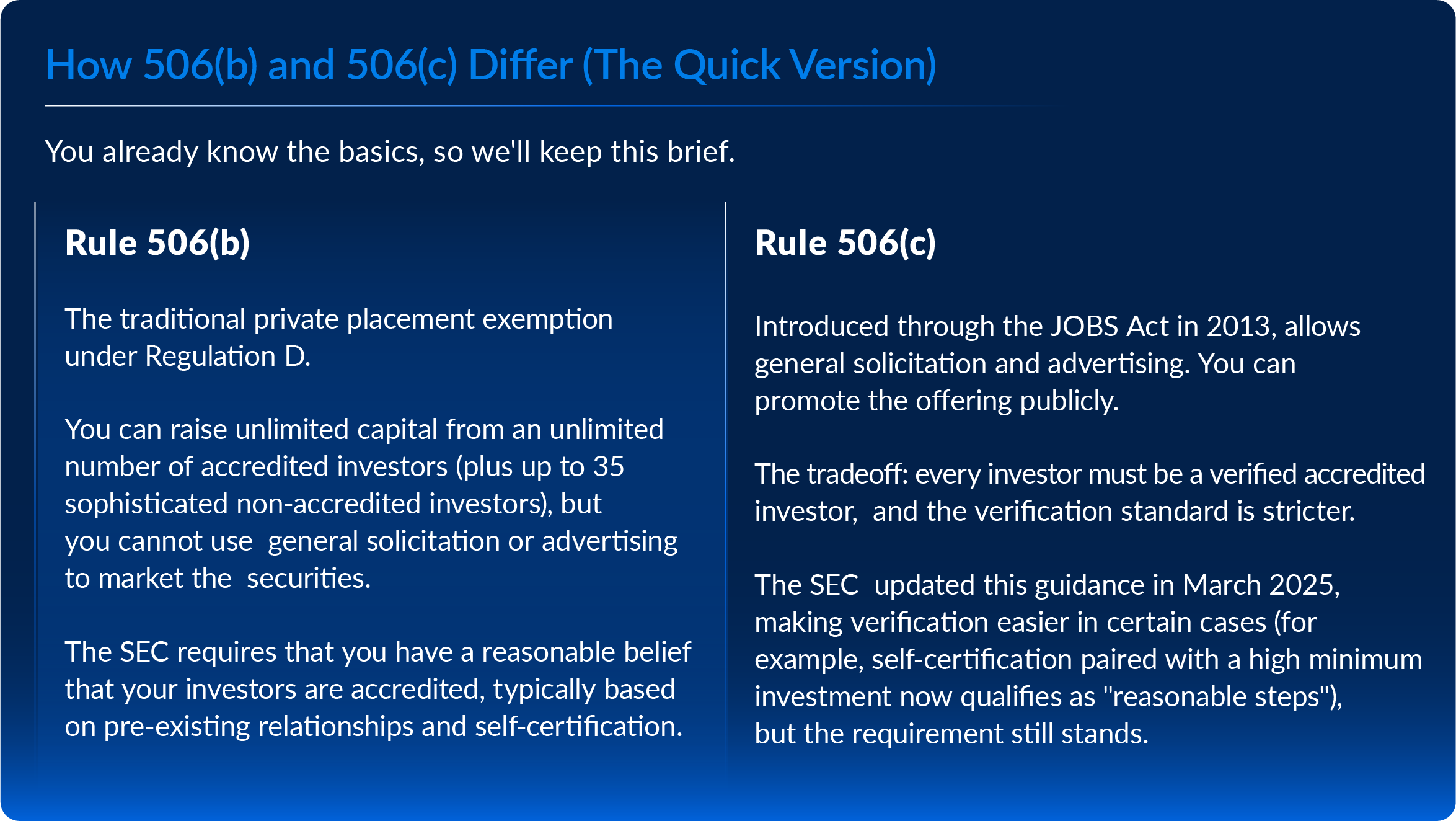
Here's what matters for marketing: 506(b) restricts what you say. 506(c) restricts who you sell to. Both leave plenty of room for a digital strategy.
How You Frame It Changes EverythingMarketing Under 506(b): More Opportunity Than You Think
The "no general solicitation" rule trips up a lot of firms. They hear "no advertising" and assume they need to sit on their hands and wait for referrals. That's not how it works.
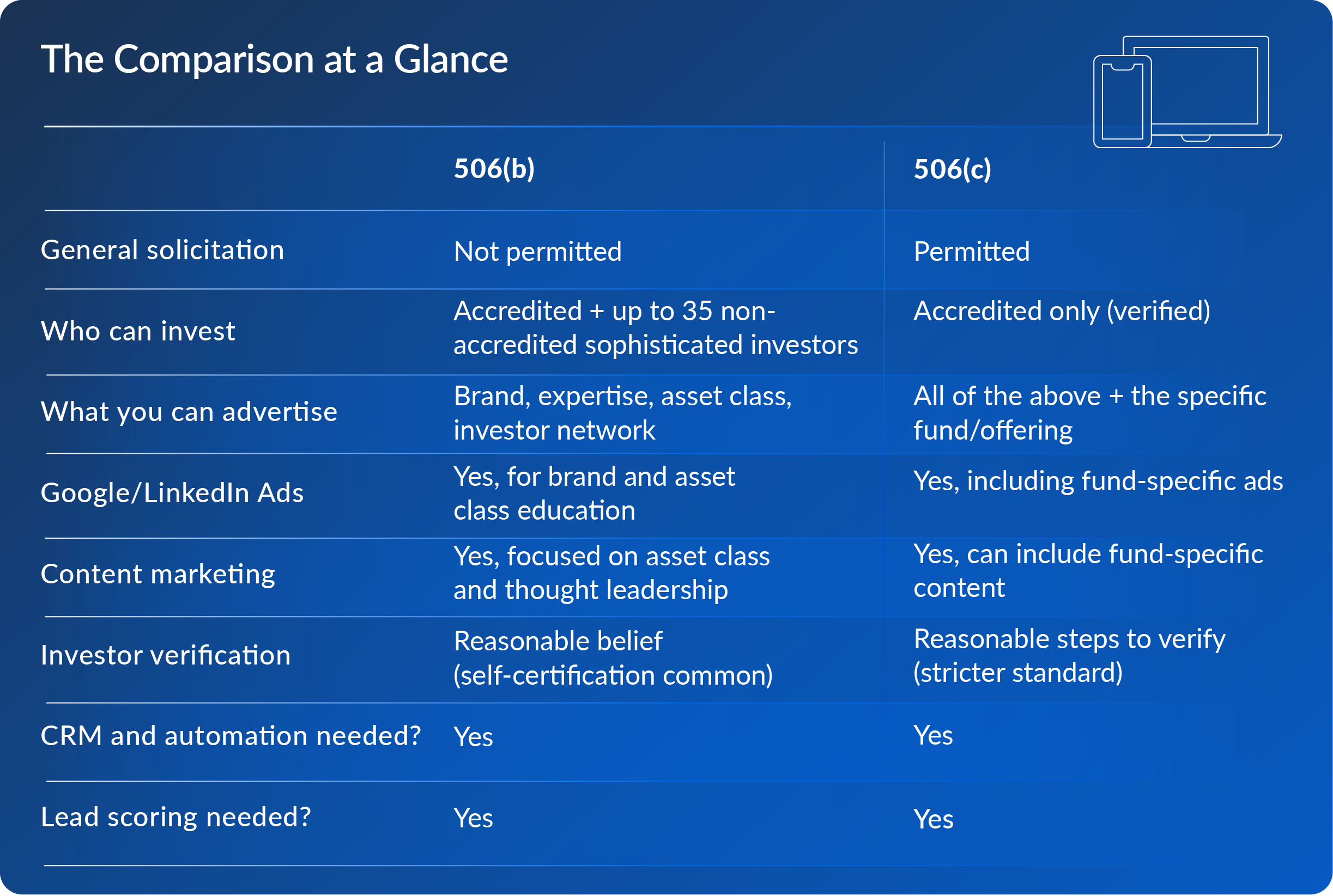
What you can't do under 506(b) is advertise the specific fund or offering. You can't run a Google Ad that says "Invest in ABC Real Estate Fund II" or send a mass email pitching your fund terms.
What you absolutely can do is market your firm, your expertise, and the asset class.
Brand and asset class marketing is fair game. You can run Google Ads promoting your firm's expertise in a specific asset class. Think "Join our real estate investor network" rather than "Invest in Fund XYZ." You can publish blog posts about market trends in your sector. You can run LinkedIn campaigns that position your team as experts in private credit, multifamily real estate, or whatever your focus is.
The key distinction: you're attracting people to your brand and building relationships before any fund-specific conversation happens.
Here's how this works in practice. We worked with a 506(b) real estate fund that needed to generate leads targeting both individual investors and advisors. The challenge was obvious: they couldn't advertise the fund. So we ran Google Ads inviting prospects to join an investor network focused on real estate insights, market data, and educational content. No mention of the specific fund. No offering details.
Once prospects entered the system, we built the infrastructure to qualify them. Were they accredited? Were they a good fit? Only after that qualification step did the sales team have a fund-specific conversation. The marketing brought people in. The process determined who could move forward.
That's the difference between "we can't market" and "we need to market smarter."
Content is critical here. Under 506(b), your content strategy is your top-of-funnel engine. Blog posts, whitepapers, webinars, and email newsletters about the asset class all serve a purpose: they answer the questions investors and advisors are already asking, and they build trust before your team ever picks up the phone. If a prospect has already read three of your articles on private real estate investing before they get on a call, that conversation is fundamentally different.
Marketing Under 506(c): Broader Reach, Same Infrastructure Needs
506(c) gets a lot of attention because of the general solicitation permission. And yes, it opens up channels that 506(b) doesn't. You can run ads that reference the fund directly. You can promote specific terms and investment minimums. You can use paid social, search ads, email campaigns, and even traditional media to get the offering in front of potential investors.
But here's what a lot of 506(c) issuers miss: the ability to advertise doesn't replace the need for infrastructure.
You still need a way to capture leads when they respond to your ads. You still need content that educates prospects and moves them through the funnel. You still need a system to score those leads and route the most engaged ones to your sales team. And you still need a verification process to confirm accredited status before anyone invests.
The firms that treat 506(c) as "just run some ads and see what happens" burn through budget fast. The ones that pair general solicitation with a real marketing system are the ones raising capital efficiently.
The Infrastructure That Matters for Both
Whether you're running a 506(b) or a 506(c), the underlying digital infrastructure is the same. The messaging changes. The tools don't.
A CRM built for the job. HubSpot is what we use with most of our fund marketing clients because it handles the full lifecycle: contact management, email automation, lead scoring, and reporting, all in one platform. Your CRM should track every touchpoint from first website visit to qualified investor, so your team knows exactly where each prospect stands.
Lead scoring. Not every person who downloads a whitepaper is ready for a call. Lead scoring lets you assign values based on behavior (pages visited, emails opened, content downloaded) and demographics (accredited status, investment history, AUM for advisors). When a lead hits a threshold, your team gets notified. This is how you prioritize outreach instead of chasing everyone equally.
Content that answers real questions. Investors and advisors do their research before they take meetings. If your website doesn't answer the questions they're already asking, like how the asset class performs, what the risks look like, or how your firm's approach differs, they'll find a competitor who does. This applies equally to 506(b) and 506(c) offerings. The only difference is whether that content mentions the specific fund.
Quality data. If you're targeting advisors, platforms like FINTRX give you the data you need to identify the right audience: RIAs, family offices, and broker-dealer reps who allocate to your asset class. Good data means your paid campaigns and outreach reach the people who actually matter, not just anyone with a LinkedIn profile.
Automation. Once someone enters your funnel, automation handles the nurturing. Email sequences that deliver relevant content based on what a prospect has engaged with. Workflow triggers that move a lead from "interested" to "qualified" to "ready for a conversation." This keeps prospects warm without your team manually following up on every single lead.
Fund materials for qualified prospects. Regardless of whether you're 506(b) or 506(c), once someone is in your pipeline and qualified, they need to see the fund materials: the pitch deck, the PPM summary, the performance data. Having these ready in a digital format that can be shared through your CRM (with tracking, so you know who opened what) closes the gap between "interested" and "invested."
The Bottom Line
Your offering structure determines what you say in your marketing, not whether you market at all. 506(b) firms can build a digital presence around their brand and asset class expertise, attract prospects into an investor network, qualify them, and then have fund-specific conversations. 506(c) firms can do all of that plus advertise the offering directly, but they still need the same infrastructure to convert interest into investment.
The firms that treat "we have a 506(b)" as an excuse not to market digitally are losing ground to competitors who figured this out. And the firms running 506(c) offerings without a real marketing system behind their ads are wasting budget.
Either way, the playbook starts with the right foundation: a CRM, content that builds trust, lead scoring that identifies who's ready, and automation that keeps the funnel moving.
Ready to build your fund's digital marketing infrastructure?
Download our Asset Manager's Guide to Digital Distribution for the full framework on attracting, qualifying, and converting investors in a digital-first world.
