


I talk to firms gearing up for a launch all the time, and there's a decision point that comes up in almost every one of those conversations. Someone on the team asks some version of the same question: should we wait until we're closer to launch to really get marketing going?
The instinct makes sense on the surface. Why build out content and infrastructure for a fund or product that doesn't exist yet? Save the budget. Save the effort. Turn it on when there's something to sell.
That's the wrong call, and it's an expensive one.
Marketing and the infrastructure behind it, your content, your CRM, your lead scoring, your sales team's talking points, take months to build real momentum. If you wait until launch week to start, you're launching into silence. And silence in that first stretch is the hardest thing to recover from, because it's the window when you have the most attention and the least to show for it.
The Honest Truth About Pre-Launch Marketing
Here's the thing nobody tells you when you're gearing up for a raise: the period between deciding to launch and actually being live isn't dead time. It's the most important window you're going to get.
That's not a sales pitch. It's how content, search visibility, and infrastructure actually work. None of it turns on overnight. Treat the months before launch as a waiting room instead of a build phase, and you show up to your own launch with nothing behind you.
Mistake #1: Assuming Content Can Wait
Content shows up in a lot of forms, lead magnets, thought leadership pieces, market commentary, case studies, whatever gets a prospect to trust you before they'll talk to you. None of it responds to your timeline. It responds to time, period.
Industry research on SEO timelines consistently finds that it takes roughly three to six months for a search strategy to produce noticeable results, and that's just for traditional search. Add AEO, how tools like ChatGPT and Claude surface and cite your content, and the same rule applies: those systems need to find and trust your content before they'll recommend it, and that trust builds over months, not days.
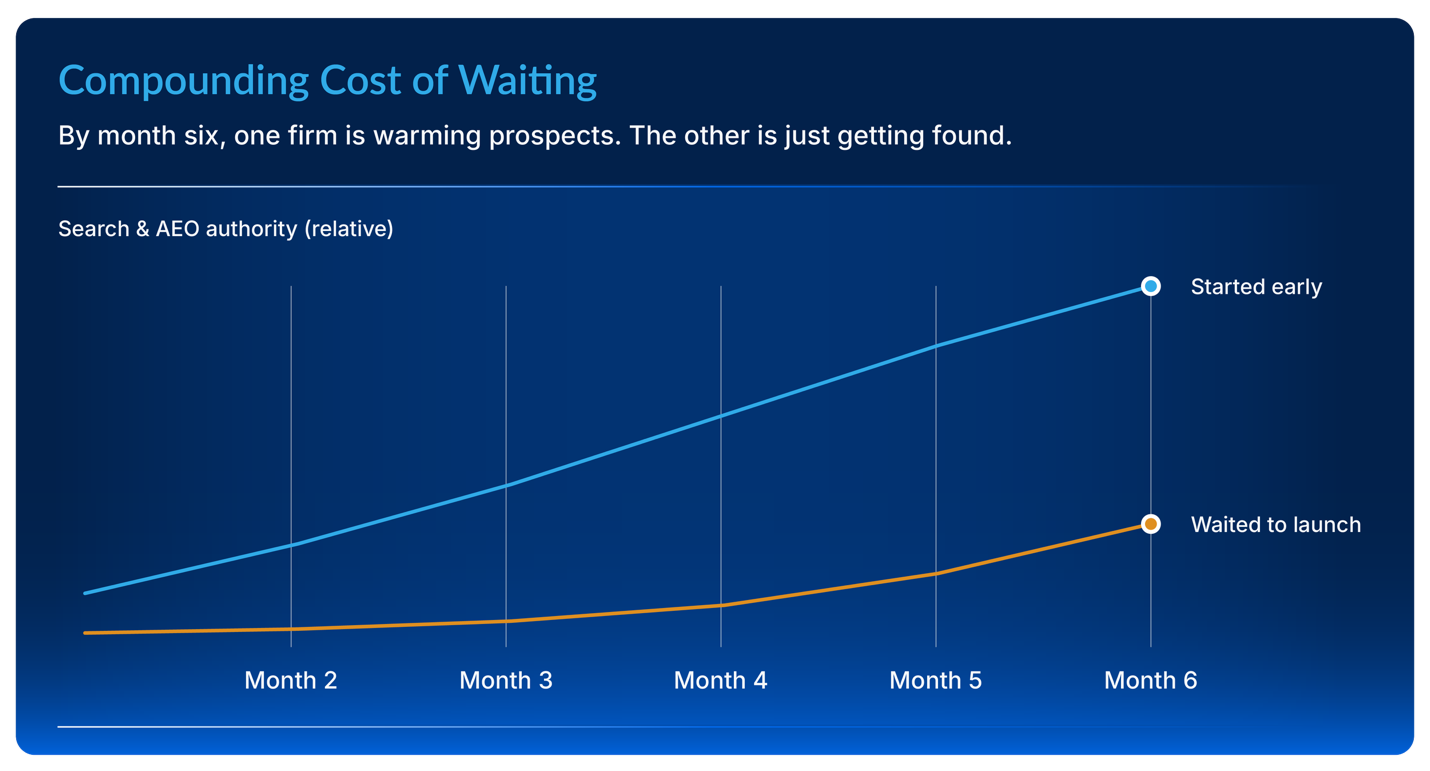
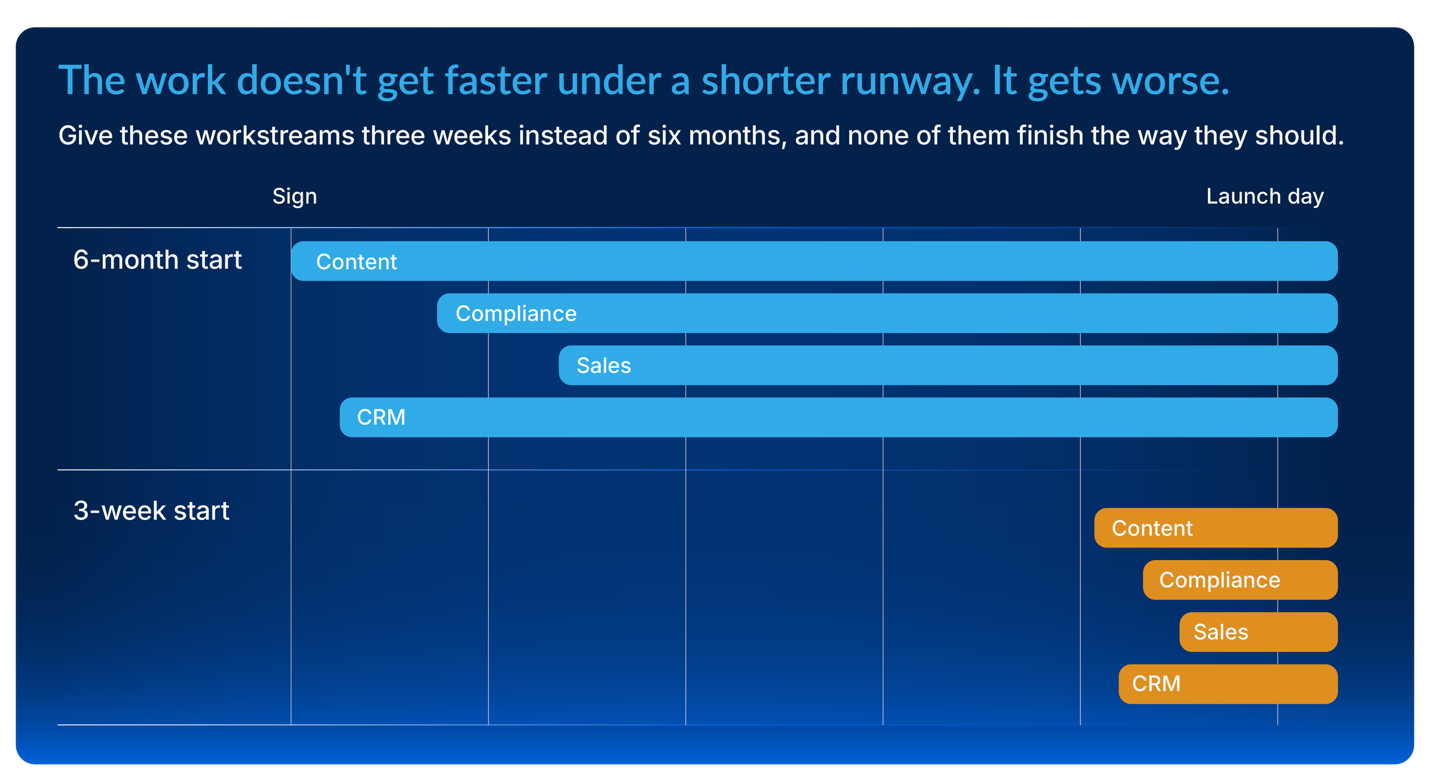
A firm that starts writing three weeks before launch isn't behind by three weeks. They're behind by three to six months, because the clock only starts once the content exists.
This is exactly why a real content and blogging strategy matters months before you need it to perform. The lead magnet that converts a prospect on launch day, the article that answers their first question, the thought leadership piece that gets you cited by an AI answer, all of it was written back when there was nothing to launch yet.
Mistake #2: Letting Compliance Review Happen Under Pressure
Every piece of content in financial services goes through review. That's not optional, and it shouldn't be rushed.
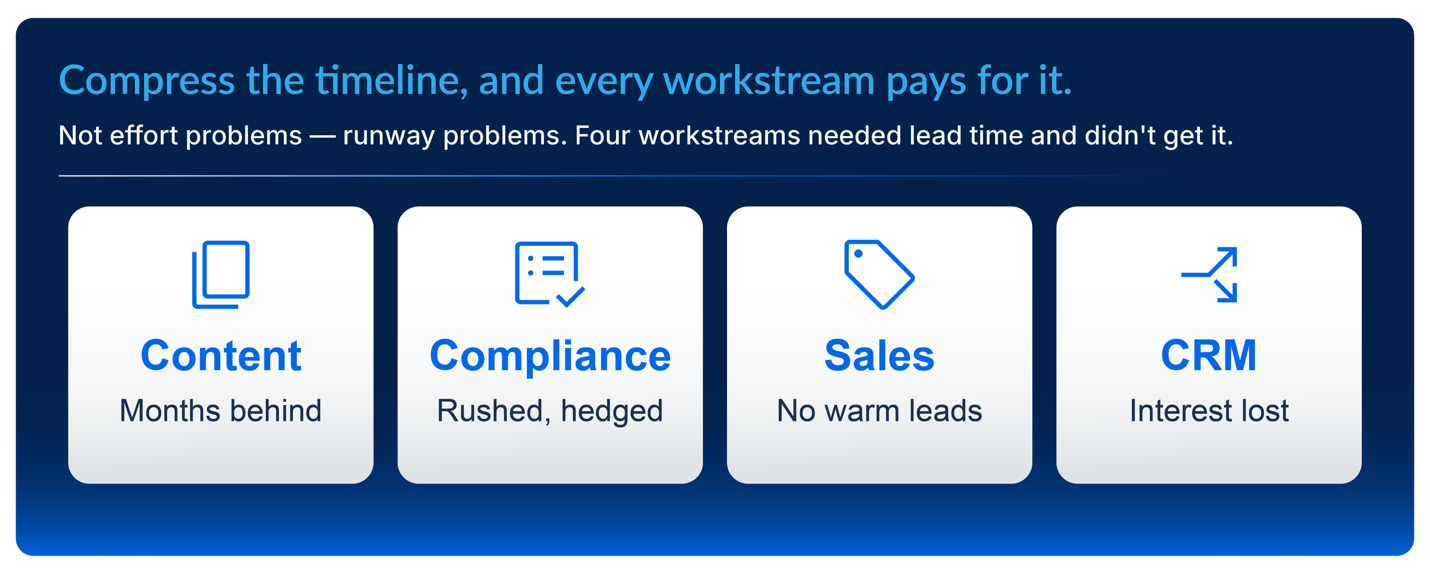
But rushed is exactly what happens when you start building content two months before launch instead of six. Compliance gets a stack of pages to review in a week instead of a month. Legal gets pulled into fire drills instead of a normal cadence. And what comes out the other side is thinner, more hedged, and less useful than it would have been with real runway.
Compliance doesn't get faster because your timeline got tighter. It just gets more stressful, for everyone.
Mistake #3: Sending Sales Out With Nothing to Warm Prospects Up
A sales or wholesaling team walking into their first calls with zero supporting content is doing the hardest version of the job. They're cold-calling people who've never heard of your firm, with nothing to point to and nothing that's already answered a prospect's first questions.
Compare that to a team whose prospects have already read a few articles about the asset class, downloaded a guide, and already understand your approach before the first call happens. That's not a different sales team. That's the same team with six months of content behind them instead of zero.
Mistake #4: Having No System to Catch the Interest Launch Creates
Launch day generates attention. Press, referrals, word of mouth, whatever the channel, something is going to bring eyes to your firm in that window. If there's no CRM, no lead capture, and no scoring system in place to catch that interest, most of it evaporates.
Building the funnel that raises capital isn't a launch-week task. It's infrastructure, and infrastructure built under a deadline is infrastructure built badly. The firms that get this right have a way to score and prioritize interest already running before launch day arrives, so nothing gets lost the moment things get busy.
The Overstated Concern: "We Can't Market Before We Have Something to Sell"
This is the one that stops firms from starting early, and it's based on a misunderstanding.
Pre-launch marketing doesn't mean promoting a specific offering before it exists. It means building brand awareness, category authority, and infrastructure. You can publish content about the asset class. You can build the CRM and lead scoring system. You can get your sales team's case studies and talking points ready. None of that requires the offering to be live, and all of it needs to exist before the offering is live to actually work.
The confusion between marketing the brand and marketing the offering costs firms months they never get back.
What This Looks Like in Practice
We're currently working with a client on retainer who signed at the beginning of the year for an August launch. There's been no shortage of work between then and now. Content, campaign infrastructure, CRM setup, all of it moving in parallel with the lead-up to the raise.
The result is a firm that's already seeing real pre-launch traction well ahead of August. When launch day arrives, they're not starting from zero. They're building on months of groundwork that's already working.
That's the difference between marketing that starts at launch and marketing that starts the day you sign.
Frequently Asked Questions
How far in advance should a firm start marketing before a launch?
Ideally, six months or more. That gives content time to build search and AEO authority, gives compliance a normal review cadence instead of a rushed one, and gives your CRM and lead scoring system time to be tested before it needs to perform under real volume.
Is it a compliance risk to market before an offering is live?
No, as long as the content stays focused on brand and category, not the specific offering. Educational content, market commentary, and firm expertise are all fair game well before launch. The specifics of the offering are what wait.
What if we only have a few weeks before launch?
Focus on infrastructure over content volume. A working CRM and lead capture system matter more in a compressed timeline than a large content library. You won't catch up on search or AEO authority in a few weeks, but you can make sure you're not wasting whatever interest does show up.
Does this apply to smaller raises, not just large fund launches?
Yes. The scale changes, but the mechanics don't. A smaller raise still benefits from prospects who already know the firm before the ask ever happens.
What's the biggest cost of waiting?
Not missed leads on launch day. It's the months of compounding you never get. A firm that starts six months early has six months of search and AEO authority and warmed prospects working for it by the time a firm that waited is just getting started.
The firms with genuine pre-launch momentum aren't lucky. They just didn't wait for a launch date to start the work that makes launch day worth having.