
Every few months we get a version of the same call. Sometimes it's a fund sponsor close to launching an ETF. Sometimes it's a firm with a fund that's been trading for two years and hasn't gained traction. Either way, the first question is usually about the sales team: how many reps, how fast can they get meetings on the calendar, what does the follow-up cadence look like.
That's the wrong starting point, whether the fund launched last month or five years ago. Not because meetings don't matter, but because most people who end up owning your ETF will never take one.
An ETF trades on an exchange under a ticker, with a live price and no minimum. Someone can find the symbol, check the spread, and buy ten shares before lunch without ever talking to your team. Mutual funds can technically be bought the same way, through a brokerage account with no advisor involved, but in practice the ETF wrapper makes that the default path, not the exception. That's the distinction that should shape your funnel, not a fund structure comparison. This isn't a compliance piece. It's about what the wrapper demands of your marketing.
The Wrapper Is the Buying Behavior
Retail investors are moving toward self-direction faster than most issuers plan for.
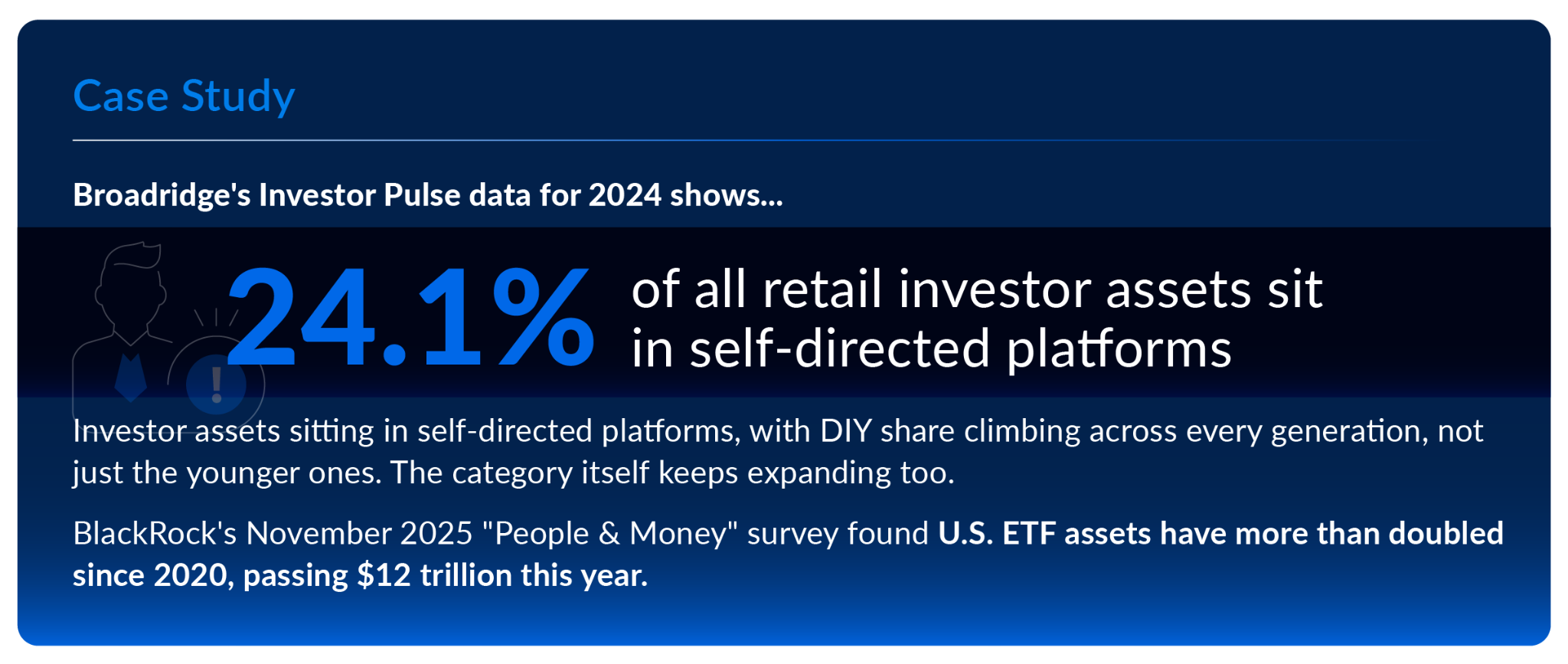
That growth is happening because the wrapper removes the steps that used to require a person. No subscription documents. No minimum investment call. No "let me get you the paperwork." Someone sees a ticker, does some research, and clicks buy in the same brokerage app they already use.
If your marketing still assumes a phone call closes the sale, you're building for an investor who doesn't exist in the volume you need.
Two Funnels, One Wrapper
This split holds whether you're building a funnel from scratch for a launch or fixing one for a fund that's already on the tape and underperforming its category.
Retail and self-directed. A sales meeting isn't just the wrong ask for this audience. It's not a workable model at all. You can't put a rep on a call with everyone buying two or three shares. The math doesn't support it, and most of these investors don't want it anyway.
Your website has to do the selling instead. That means ticker-forward calls to action instead of "schedule a consultation," interactive fact sheets that update with live holdings and performance, comparison tools that put your ETF next to the fund people are already searching for, and clear "how to buy" instructions broken out by brokerage. If someone lands on your site from a Reddit thread or a search for your ticker, they need to be able to go from curious to invested without leaving the page.
Advisor and RIA. This is where the meeting earns its cost. One conversation with an advisor can reallocate model portfolios across their entire book, which means the economics of a sales call only make sense when a single relationship scales to dozens or hundreds of end investors. That math changes what the funnel needs to do before the meeting happens. Advisors want to see a track record of thoughtful positioning before they take a call, which means SEM against category and competitor terms, segmented email built around firm size and existing holdings, and data partnerships like FINTRX to identify which advisors already hold funds similar to yours. We've covered the tactical build for this channel elsewhere, in our breakdown of how we launch ETFs with an omnichannel approach. The short version: advisors still want education before allocation, and email remains the tool that moves them through it.
The Infrastructure Carries Over, the KPIs Don't
The CRM, lead scoring, and automation stack you'd build for any fund launch still applies here. What changes is what you're scoring.
For advisors, lead scoring still tracks the same signals as any other fund: firm size, AUM, engagement with your content, competitor holdings from 13F data. That part doesn't change.
For retail, there often isn't a "lead" in the traditional sense. Nobody's filling out a form to buy an ETF. The KPI that matters shifts to ticker search volume, click-through rate to a brokerage's "buy" screen, and organic mentions across forums and social platforms. If your reporting is still built around form fills, you'll miss most of what's actually working.
The Channels That Actually Work
Programmatic advertising does the heaviest lifting for awareness. It's a top-of-funnel play with no form to fill out, built to plant your ticker in front of the right audience repeatedly until it registers. You're not capturing a lead here. You're making sure your symbol looks familiar the next time someone sees it on a screener.
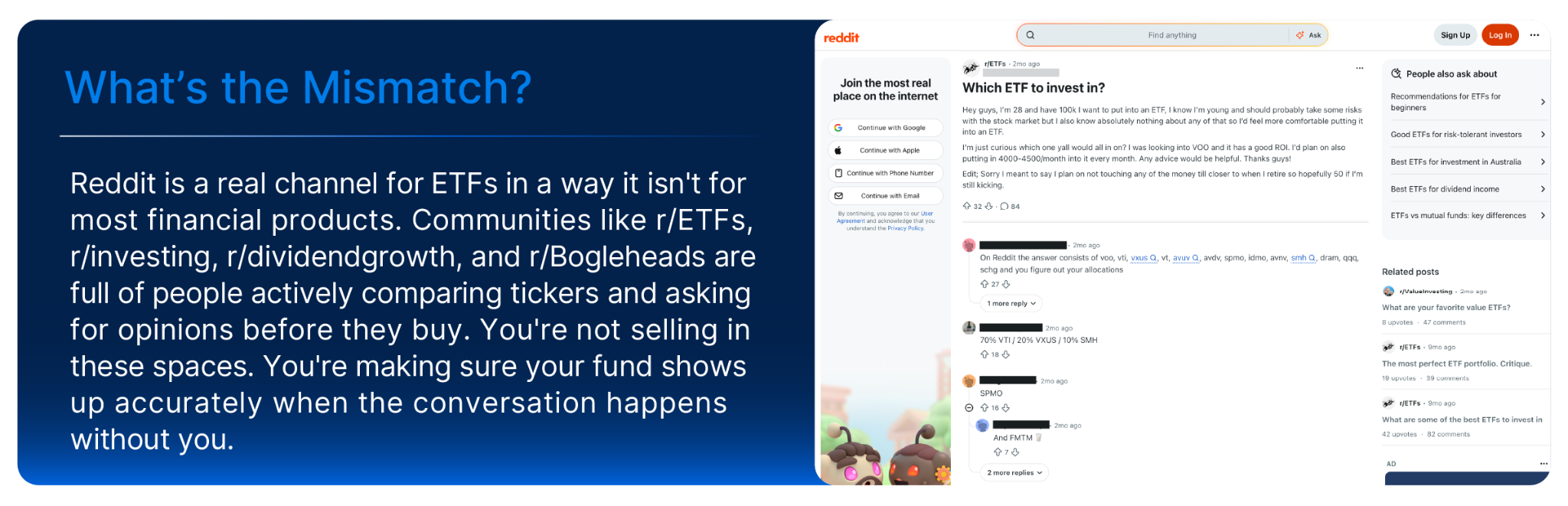
Influencer partnerships and competitor-ticker keyword bidding work well together for trader-focused ETFs. When we helped AXS launch Tradr ETFs, we built the brand around traders instead of advisors in 45 days, using both tactics: identifying influencers already trusted in the trading community, and bidding on keywords tied to competitor tickers like SOXW to capture high-intent search traffic. You can read the full Tradr ETFs launch story here.
AEO and AI Search Are Not Optional Anymore
This is the piece that's changed the most in the last two years. Investors researching ETFs increasingly skip Google altogether and ask ChatGPT or Perplexity things like "what's the best AI ETF" or "compare this ticker to QQQ." A Reuters-reported eToro survey from September 2025 found that 13% of retail investors already use tools like ChatGPT or Gemini to help pick stocks, and roughly half say they'd consider it.
Here's the part that makes this different from ranking on Google: there's no editor, no fact-checker, and no gatekeeper standing between an AI model's answer and the investor reading it. If the model cites a competitor's fund because their fact sheet is cleaner or their data is easier to parse, that's the answer the investor gets. Being the source an AI model trusts matters more here than it does for almost any other financial product.
To show up in those answers, your ticker and fact sheet pages need to answer the question directly in the first few sentences, present holdings and performance in clean tables rather than PDFs, phrase your FAQ the way a person would actually type a question, and earn citations on the third-party sources AI models already treat as credible in this space.
What This Looks Like When It Works
This isn't only a launch strategy. One ETF provider we worked with already had a fund trading, sitting around $500 million in AUM, when they came to us. Roughly a year and a half later, driven primarily by a full brand rebuild paired with this retail-first, trader-friendly approach, that fund had grown past $7 billion. No sales team expansion drove that growth. A clearer brand and a funnel built for people who buy without talking to anyone did.
The Bottom Line
The wrapper doesn't change whether you need a real marketing strategy, whether the fund is about to launch or has been trading for years without traction. It changes who you have to convince without a human in the room, and how many of them there are. Retail investors need a website that sells for you and a presence in the places they already research, including AI search. Advisors still need the education-first approach that earns the one conversation that reallocates their book.
Get either funnel wrong and you're either burning budget on meetings nobody wants, or leaving the advisor channel to build itself. That's true on day one of a launch, and it's just as true two years in.