


Most reputable marketing agencies don't work on pure performance fees. And it's not because they're avoiding accountability. It's because they don't control whether your leads become clients. That part is up to you.
If you're asking this question, you're probably trying to protect yourself from paying for marketing that doesn't deliver. That's smart. But performance-based pricing creates problems that hurt both sides. Here's why the model doesn't work, what real accountability looks like, and what to ask agencies instead.
Why Most Agencies Won't Work on Performance Fees
The logic behind performance fees sounds reasonable: pay for results, not activity. But marketing isn't a transaction with a clean input-output relationship. It's a system with multiple variables, and agencies only control some of them.
The core issue is simple. An agency can drive traffic to your website, generate leads, and fill your pipeline with qualified advisor prospects. But they can't control whether your team follows up, how quickly compliance approves materials, whether your product is competitive, or how well your wholesalers close.
Marketing creates opportunity. Sales converts it. Tying agency compensation to conversions means paying (or not paying) them for outcomes they can't influence.
The Attribution Problem
Say an advisor downloads your whitepaper in January, attends a webinar in March, clicks a LinkedIn ad in June, and finally takes a meeting in September. They invest in November.
Who gets credit? The whitepaper? The webinar? The ad? The wholesaler who closed the deal?
In financial services, buying cycles stretch months or years. Prospects engage across dozens of touchpoints before converting. Clean attribution is nearly impossible, and the ROI challenge only gets harder when compensation depends on solving it perfectly.
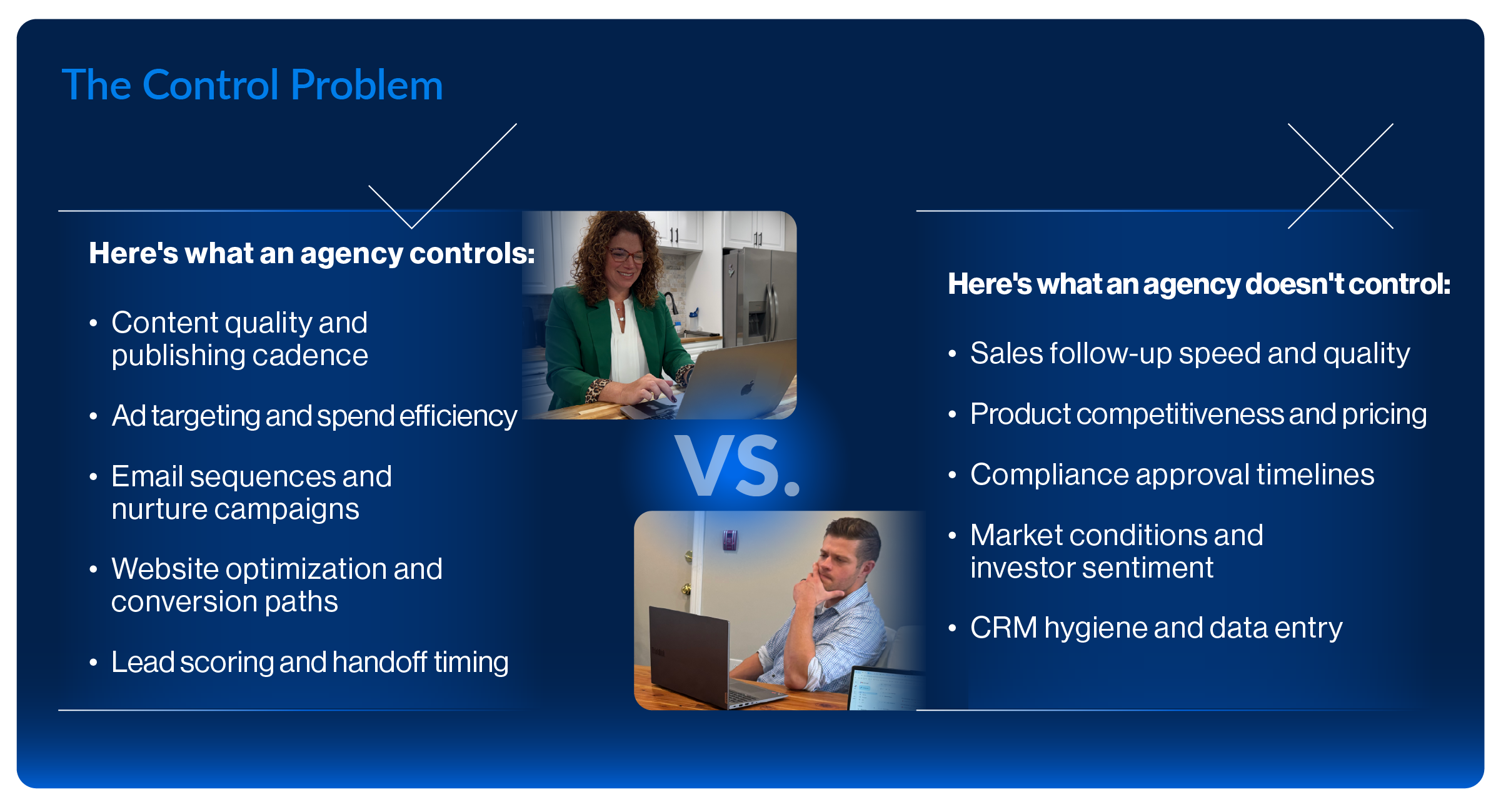
If leads come in but don't convert, performance fees punish the agency for problems they can't fix. If leads convert because of a great sales team, performance fees reward the agency for work they didn't do.
The Quality Problem
Performance fees incentivize volume over quality. When agencies get paid per lead, they optimize for more leads, not better ones.
That means aggressive paid campaigns, gated content with low barriers, and quantity metrics that look good in reports but don't translate to pipeline. Short-term tactics win. Long-term brand building loses.
You don't want an agency optimizing for their compensation structure. You want one optimizing for your business outcomes.
The Desperation Problem
Agencies have real costs: salaries, software, overhead. They can't pay their team based on "when results eventually come in."
If an agency agrees to pure performance fees, ask yourself why. Usually it's one of two reasons.
First, they're desperate for revenue. They'll say yes to anything to get work in the door, which tells you something about their pipeline and reputation.
Second, they have a templatized approach. They're betting they can plug you into a cookie-cutter system with minimal effort. If it works, great. If it doesn't, they haven't invested much anyway.
Neither scenario gets you a strategic partner invested in your specific growth.
What Real Accountability Looks Like
Rejecting performance fees doesn't mean rejecting accountability. Good agencies are accountable. They just use structures that actually work.
|
Element |
What It Looks Like |
|
Clear KPIs upfront |
Defined metrics tied to what marketing can control |
|
Regular reporting |
Monthly or quarterly reviews against those KPIs |
|
Transparent dashboards |
Real-time access to performance data |
|
Strategic adjustments |
Willingness to change course when something isn't working |
|
Defined exit terms |
Clear off-ramp if results don't materialize over reasonable timeframes |
The KPIs that actually matter for growing AUM are the ones marketing can directly influence: awareness metrics like website sessions and engagement, lead volume and quality scores, and conversion rates from lead to meeting.
Can you track whether those leads become investors? Yes, but only if your team enters that data into your CRM. Attribution requires collaboration. An agency can build the tracking infrastructure, but they can't force your wholesalers to log their activities.
What transparent pricing looks like:
Some agencies (including us) use points-based models where you know exactly what you're getting. Each deliverable has a point value. You buy a block of points. You see precisely where they go.
No mystery retainers. No vague "strategy" line items. No wondering what you're actually paying for.
What to Ask Instead of "Will You Work on Performance?"
The performance fee question is usually trying to answer a deeper concern: how do I know this will actually work?
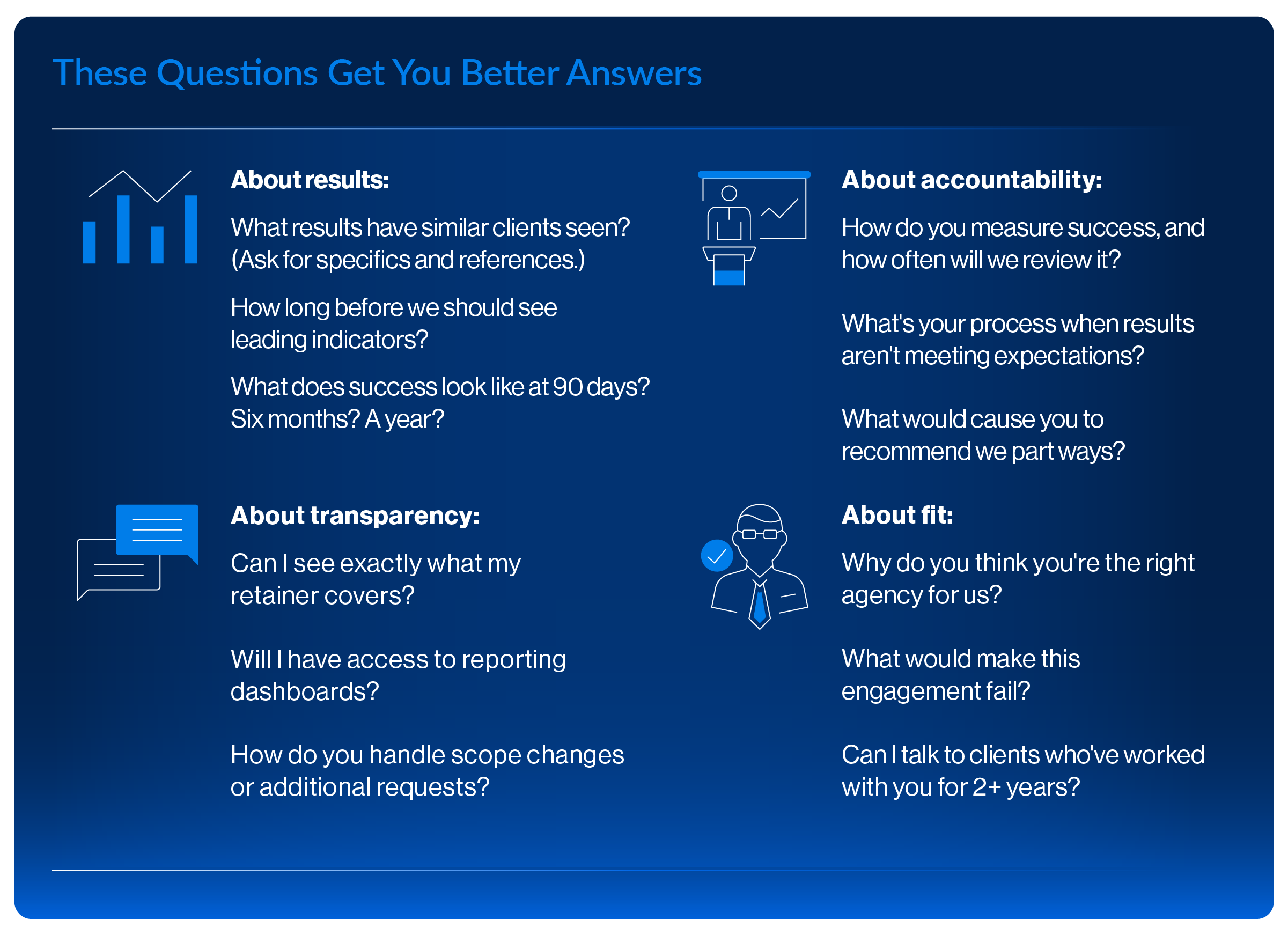
These questions reveal more about an agency's competence and integrity than asking about performance fees ever will.
The Real Question Behind the Question
When distribution leaders ask about performance fees, they're usually expressing one of these concerns:
- "I've been burned by agencies before and want protection."
- "I'm not sure digital marketing actually works for asset managers."
- "I need to justify this spend to my CEO or board."
All valid. But performance fees don't solve any of them.
Protection comes from clear contracts, transparent reporting, and defined exit terms. Confidence comes from case studies, references, and realistic timelines. Justification comes from agreed-upon KPIs that you review together.
If an agency can't provide those things, the problem isn't their fee structure. It's their ability to deliver.
Frequently Asked Questions
Do any reputable agencies work on performance fees?
Very few, and usually only in narrow situations like affiliate marketing or lead gen with extremely short sales cycles. For B2B financial services with 6-18 month buying cycles, it's essentially unworkable.
What about hybrid models with performance bonuses?
These can work when structured fairly. A base retainer plus bonuses for hitting defined milestones is reasonable. But the base needs to cover real costs, and the milestones need to reflect what marketing can actually control.
How do I protect myself from paying for marketing that doesn't work?
Clear KPIs, regular reporting, transparent pricing, and defined exit terms. If an agency won't commit to those, that's your red flag, not their fee structure.
What's a reasonable timeline to evaluate marketing results?
For inbound marketing in financial services, expect 3-6 months to see leading indicators (traffic, engagement, leads) and 6-12 months or more for lagging indicators (meetings, pipeline, AUM). Anyone promising faster results is either running pure paid acquisition or overpromising.
The Bottom Line
Performance fees sound like accountability, but they're actually a misalignment of incentives. They punish agencies for outcomes they can't control and reward them for optimizing the wrong metrics.
Real accountability comes from transparency: clear pricing, defined KPIs, regular reporting, and honest conversations when things aren't working.
If you want to understand how that looks in practice, our Services Catalog breaks down exactly what's included at each engagement level, with transparent, points-based pricing and the KPIs we track.

