

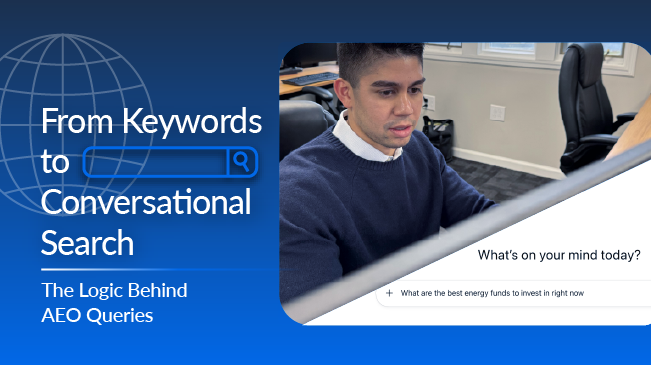
I get this question constantly from prospective clients when they first see their AEO audit results:
“Why are these queries so long? Where’s the search volume data? Why do they sound so… conversational?”
It’s a fair question. If you’ve spent years optimizing for Google, these queries look nothing like what you’re used to.
Here’s why.
The Shift from Keywords to Conversations
When you search on Google, you type short phrases:
- Investment advisor in New Jersey
- ESG fund performance
Maybe three words, tops.
The average AI query is 26 words long.
That’s not a typo. Twenty-six words.
People don’t use AI platforms like search engines. They use them like advisors. They ask complete questions with context, nuance, and their specific situation baked in.
“I’m a financial advisor managing portfolios for high-net-worth clients in their 60s who are concerned about market volatility—what alternative investment strategies should I consider that balance income generation with capital preservation?”
That’s how real people ask real questions on ChatGPT and Perplexity. That’s the framework.
Key Point: AI search reflects how people think and speak, not how algorithms parse keywords.
Why Tone and Sophistication Matter
At GK3, we’ve worked in financial services for decades. Sales distribution, asset management, advisory practices—we know how these audiences think and speak.
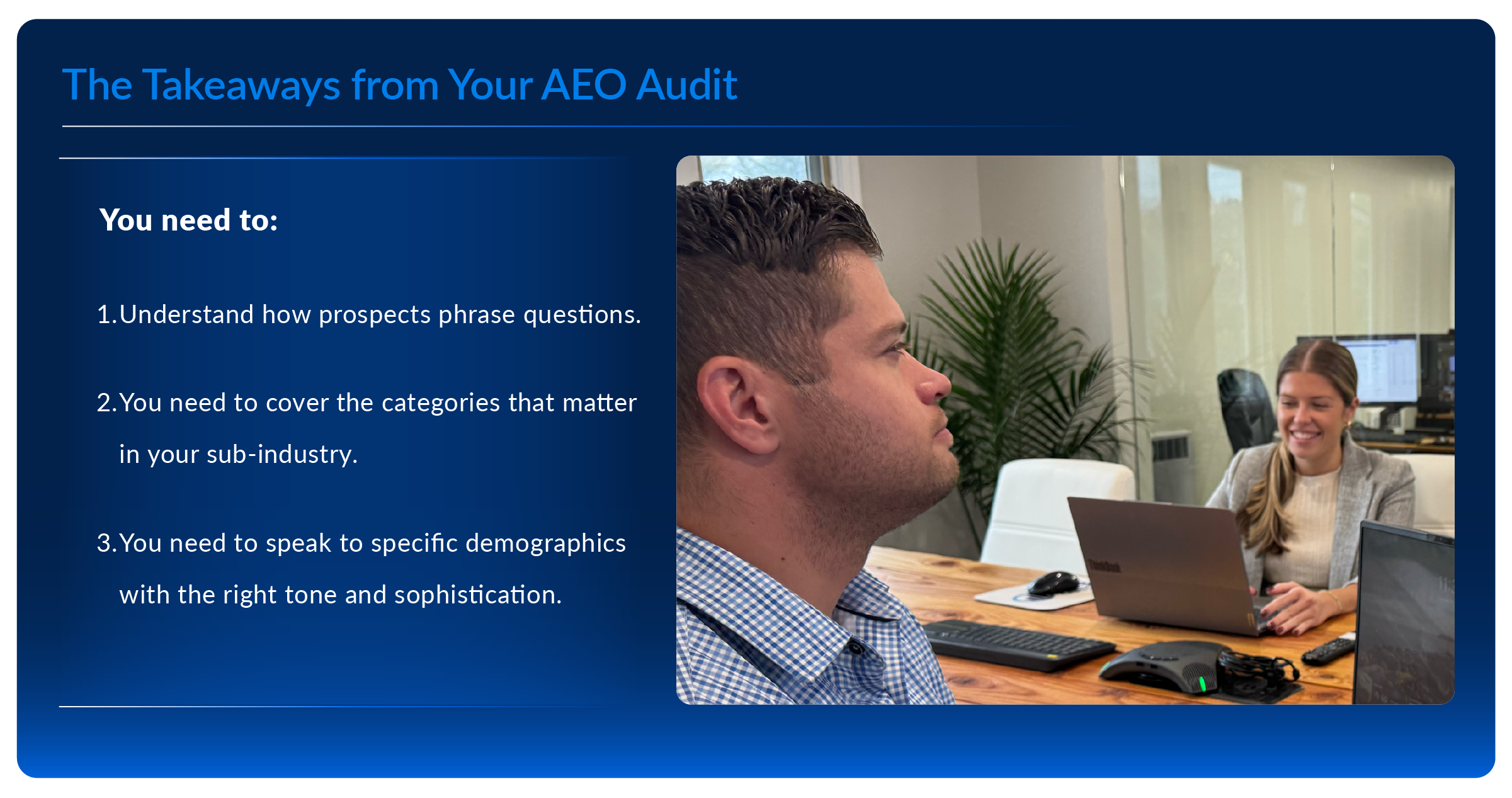
An RIA managing client portfolios asks different questions than a retail investor.
For example, advisors need to know:
- How do I explain this strategy to clients?
- Where does this fit in a diversified portfolio?
The individual investor asks:
- How exposed is my principal during market downturns?
- What trade-offs am I making between yield, risk, and access to capital?
Same topic. Different phrasing. Different focal points.
We tailor query tone and sophistication based on your target audience:
This isn’t guesswork. It’s built on years of understanding how each demographic frames their questions.
Key Point: The right query mirrors the audience’s phrasing and mindset, not just the topic.
The Search Volume Question Everyone Asks
Here’s the objection I hear most:
“If there’s no search volume data, how do I know these queries matter?”
Fair question. But here’s the reality.
AI platforms don’t publish search volume metrics. ChatGPT, Perplexity, and Claude—none of them provide keyword or search query volume data like Google.
That doesn’t mean we’re flying blind.
We still use SEO category knowledge as our foundation. We know which broad topics get searched most in your sub-industry. We know the big buckets.
Then we transform those categories into conversational queries that mirror how people actually ask AI assistants for help.
And here's the thing: even if AI platforms eventually release search volume data, it won't look like SEO metrics. AI interprets the meaning behind queries rather than matching keywords. The hyper-specific nature of conversational search means you can't predict exact phrasing.
You need to cover the categories that matter. That's what we do.
Key Point: In AEO, topic authority matters more than exact keyword volume.
Natural Language Over Keyword Stuffing
Traditional SEO trained us to think in short phrases:
- Best ESG funds
- Top financial advisors near me
AI doesn’t work that way.
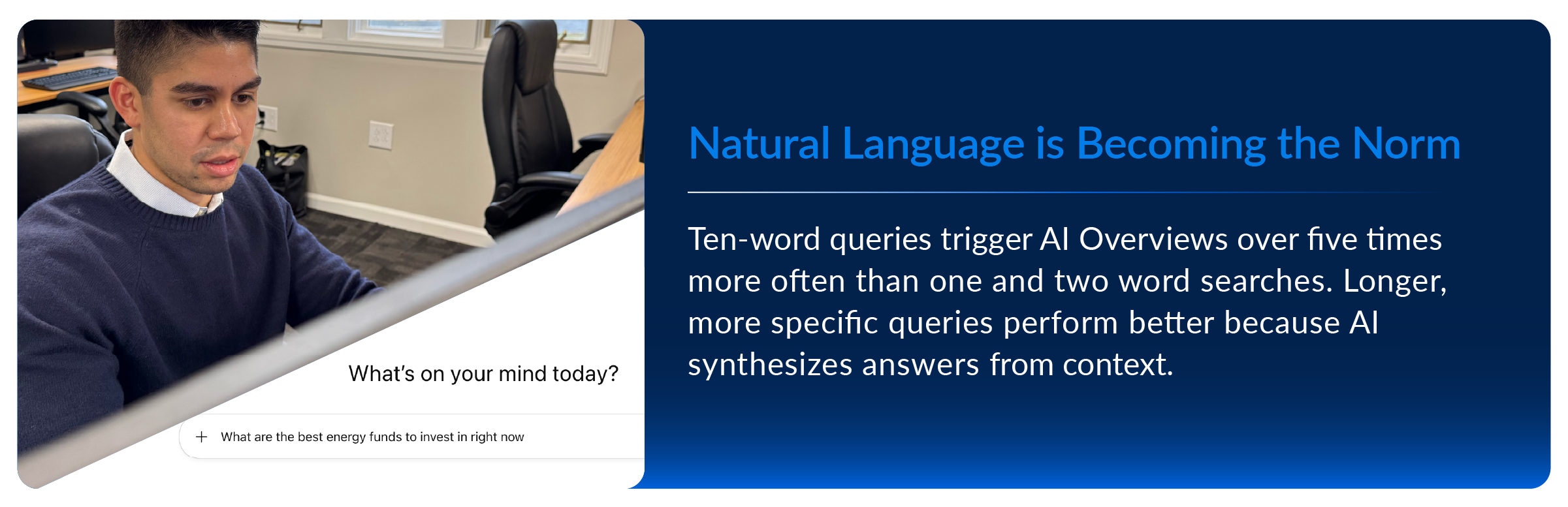
Compare these two:
- DST 1031 exchange tax
- What are the tax implications of investing in a Delaware Statutory Trust for a 1031 exchange compared to traditional real estate?
The first is keyword optimization.
The second is how people actually ask AI questions.
AI rewards the second approach.
Key Point: Natural language and context outperform fragmented keywords in AI search.
Balancing Educational and Service-Aligned Intent
When we onboard a new client, we ask:
Do you want more educational queries or more service-aligned queries?
Sometimes clients have strong preferences. Often they don’t.
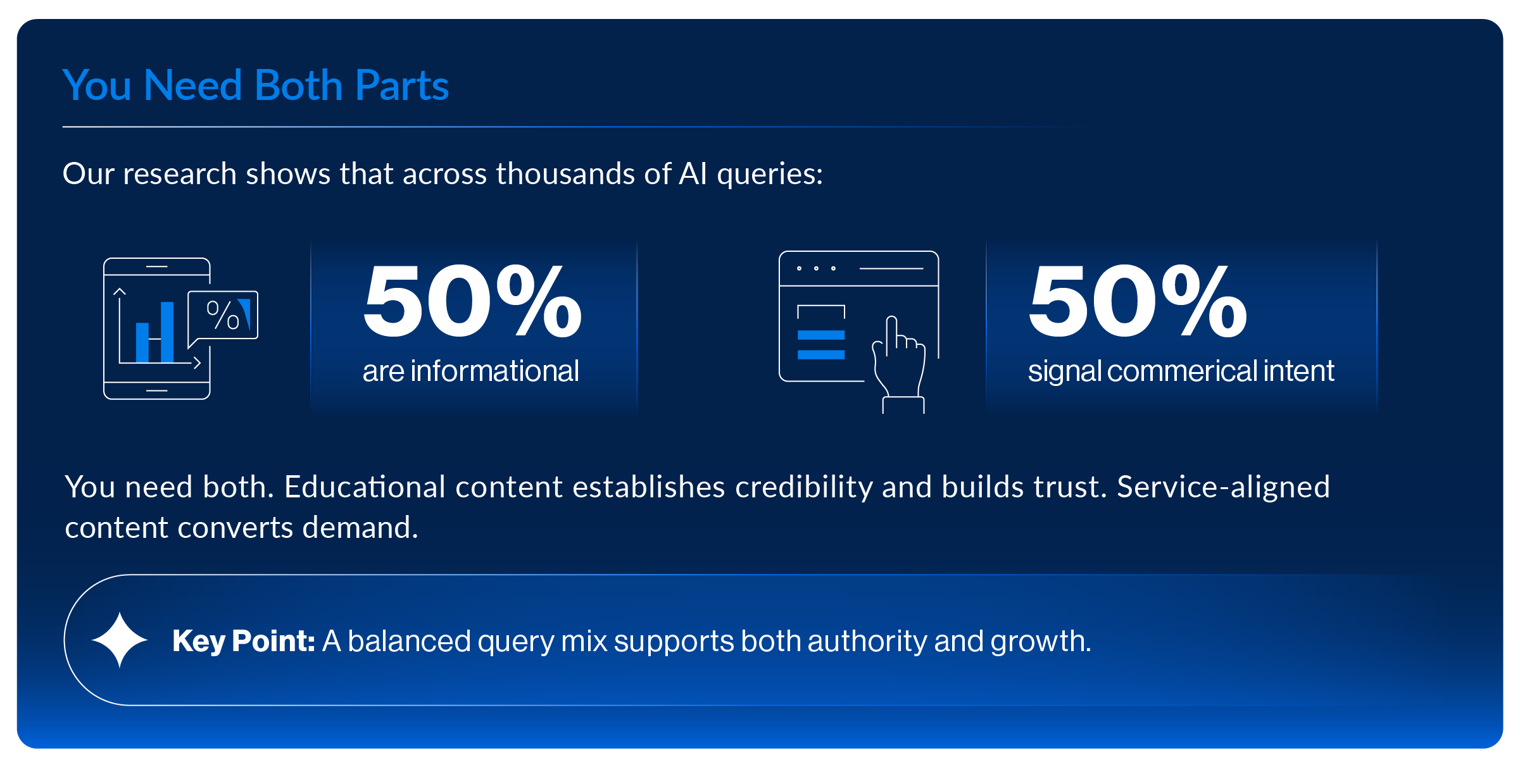
When they don’t, we default to a 50/50 split:
- Educational queries → authority and trust-building
- Service-aligned queries → prospect capture
How Competitor Analysis Shapes Query Phrasing
When we analyze your website and your competitors’ sites, we’re not just reviewing services.
We’re extracting language patterns:
- Taglines that resonate
- Terminology investors already respond to
- Phrasing that signals credibility
If competitors use language that clearly connects with investors, we reflect that language in query phrasing. Not to copy—but to align with how your market already talks.
This prevents us from creating queries in a vacuum.
Key Point: Effective AEO mirrors the language your audience already uses.
The Manual Query Advantage
We let you inject up to five custom queries into every audit.
Why?
Because:
- You know your business better than anyone.
- You know the specific questions prospects ask.
- You know the objections that come up in sales conversations.
- You know the niche positioning you're trying to own.
Manual queries let you test those hypotheses. They also give us insight into what matters most to you, which helps refine the algorithm for future query generation.
When you're generating hundreds of queries, adding a few specific ones you're personally curious about is easy and makes the audit more fun.
Key Point: Human insight strengthens algorithmic analysis.
What This Means for Your Content Strategy
Your AEO audit isn’t just a list of queries.
It’s a prioritized roadmap of your content gaps.
We categorize queries into ten buckets:
- Industry monitoring
- Competitor benchmarking
- Operational training
- Foundational understanding
- Real-world examples
- People-focused content
- Trend explanation
- Pain point content
- Commercial intent
- Decision-stage queries
We then prioritize those categories based on your sub-industry. For one client, foundational education and trends may matter most. For another, commercial intent and competitor benchmarking drives the most results.
We show you:
- Where you’re visible
- Where you’re missing
- Exactly what category or demographic you need to close the gap in
- Examples of topic titles within that category or demographic
Example:
“You’re appearing 1% of the time for Trend explanation. Here are three topics to focus content towards to improve that.”
That’s actionable. That’s useful.
Key Point: AEO turns visibility gaps into clear content priorities.
The Bottom Line
AEO queries look different because AI search is different.
It’s:
- Conversational, not keyword-based
- Hyper-specific, not broad
- Intent-driven, not algorithm-fragmented
That’s what we’ve built into our methodology.
It’s not arbitrary.
It’s not guesswork.
It’s decades of financial services experience combined with a deep understanding of how AI platforms surface content.
If you’re still thinking about AI visibility in SEO terms, you’re preparing for the wrong game. The rules changed. The queries changed. The way prospects find you changed.
Your content strategy needs to change too.
Want to see how your firm shows up in AI search results?
Let’s run an audit and identify exactly where your visibility gaps are—and what content will fix them.
Schedule Your Free Audit Here!
Key Takeaways
- AI queries reflect full conversations, not keyword fragments
- Query tone must match audience sophistication
- Search volume is replaced by category coverage
- Natural language outperforms keyword optimization
- AEO audits create actionable content roadmaps
Frequently Asked Questions (FAQ)
Q1: Why are AI search queries much longer than traditional keywords?
A1: People treat AI tools like advisors, not search engines. They ask full questions with context, nuance, and personal constraints included.
Q2: If there’s no search volume data, how do I prioritize content?
A2: Prioritization shifts from individual keywords to topic categories. Covering high-value themes consistently matters more than exact phrasing.
Q3: How does AEO differ from traditional SEO strategy?
A3: SEO optimizes for keyword matching, while AEO optimizes for intent, context, and conversational relevance across AI platforms.
Q4: Do educational queries really drive business results?
A4: Yes. Educational content builds authority and trust, which supports conversion when prospects move into service-aligned or decision-stage queries.
Q5: How does GK3 ensure queries match investor language?
A5: GK3 draws on decades of financial services experience and competitive language analysis to mirror how each investor segment actually asks questions.
