


I see it all the time. A financial services firm finally gets its marketing dialed in. Leads start flowing. Then everything freezes.
The team stares at the dashboard. Should we call? Email? Text? How fast is too fast? What if we come across as desperate? This is paralysis by options. And it's costing you conversions every single day.
At GK3 Capital, I've spent eight years helping financial firms bridge the gap between lead generation and conversion. Over that time, we've helped close to 100 firms who collectively manage billions of dollars implement this process. Today, we work with approximately 25 firms managing over $60 billion in assets. We speak both languages: digital marketing and financial services. That means we understand both the speed required in modern marketing and the compliance constraints you operate within.
In this article, you'll discover the exact playbook we use to manage leads based on their buying journey stage, why speed alone isn't enough, and how to balance automation with personalized engagement to convert more prospects into clients.
Key Takeaways
- Respond within the first hour, but make sure your response matches where prospects are in their buying journey
- Build stage-specific nurture sequences: educational content for awareness stage, proof points for consideration stage, and clear next steps for decision stage
- Use behavioral intelligence: what they engage with tells you more than form fields ever could
- Use progressive profiling: ask different qualifying questions over time based on engagement, not everything upfront
- Plan strategic human touchpoints that reference actual engagement, not generic interest
- Start with process, not technology: map your playbook first, then find tools that support it
The Real Problem Isn't Channel Choice
Most firms think they're stuck on a tactical question. Phone versus email versus text.
But that's not the actual problem.
The real issue is the absence of a process, and more specifically, treating every lead the same regardless of where they are in their buying journey. When leads start coming in and you don't have a playbook that accounts for context, every lead becomes a unique decision point. Your team burns energy debating the same questions over and over instead of executing.
At GK3, we call this the lead management gap. You've solved lead generation. Now you're discovering that's only half the battle.
How Fast Should You Respond to a Lead?
Here's what most financial services firms get wrong about response time.
They think 24 to 48 hours is acceptable. Maybe even good.
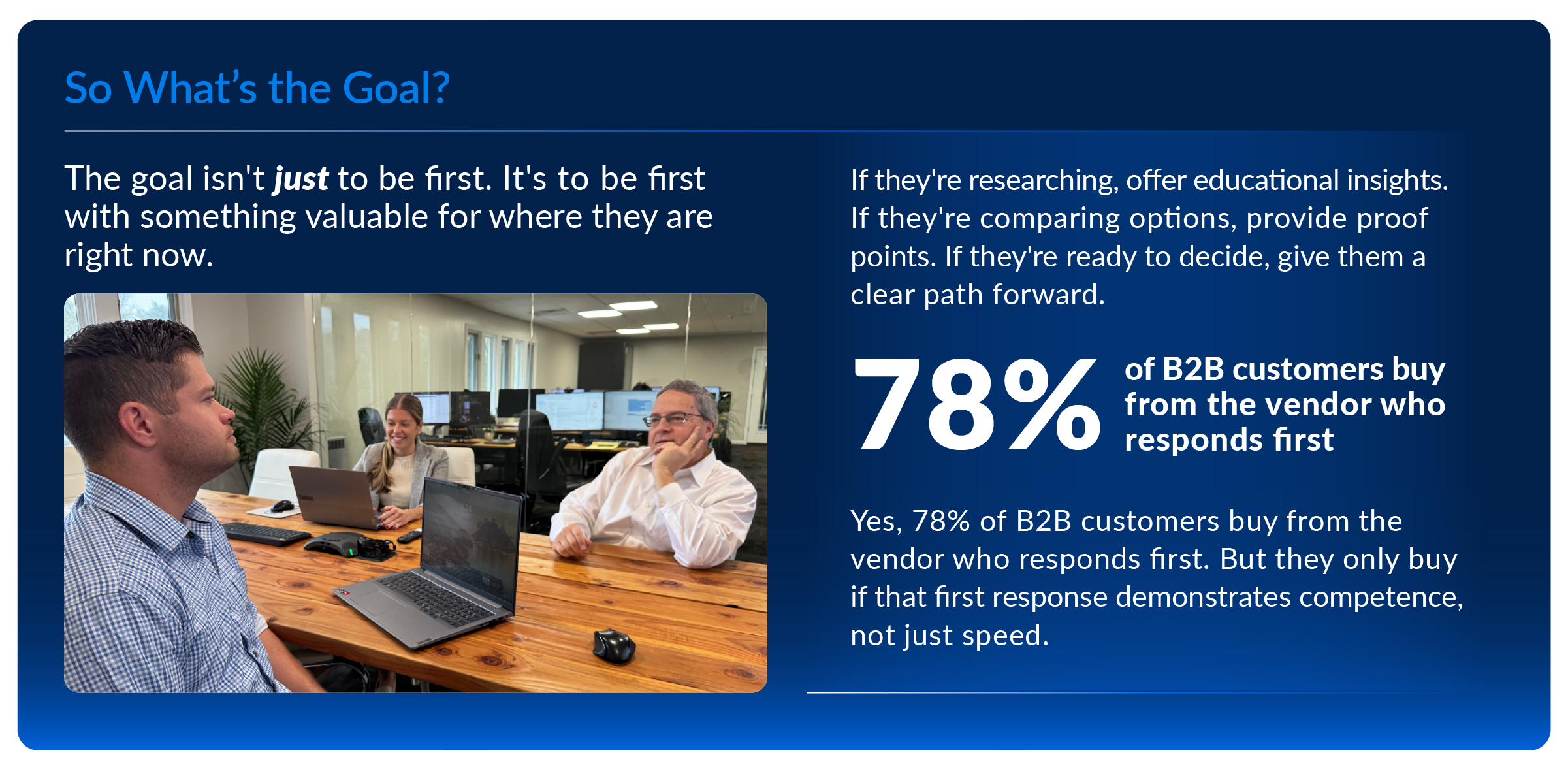
It's not. Research shows responding within 5 minutes makes you 21 times more likely to qualify a lead compared to waiting just 30 minutes. After the first hour, engagement likelihood drops significantly.
But here's what speed doesn't do: it doesn't replace substance.
Responding in five minutes with a generic "Thanks for your interest, when can we talk?" is barely better than waiting two days. Speed gets you in the door. What you say and how you engage determines whether you stay in the conversation.
 How Do You Build a Lead Management Playbook?
When we work with a new client at GK3, the first thing we build together is their playbook. This is the collaborative process that defines exactly what happens when a lead comes in.
But here's what most firms get wrong: they think every lead should get the same immediate response.
Your next action depends entirely on what the prospect just engaged with.
Did they download a guide on "Understanding Alternative Investments"? That's awareness stage. They're researching. Pushing them toward a sales call is premature. Instead, nurture them with educational content that helps them define their problem.
Did they attend a webinar or watch an on-demand session on your website? That's consideration stage. They've invested time to hear your perspective and see how you think. Now a scheduling page makes sense. They're ready to talk.
Did they request a specific case study about firms like theirs? That's decision stage. They're close. A direct calendar link with a clear value proposition ("Let's discuss how this applies to your situation") is exactly what they need.
This is where understanding the buyer's journey becomes critical. What someone engages with tells you where they are. Your immediate response should match that stage.
Step 1: Build Stage-Specific Nurture Sequences
For awareness-stage prospects: Educational sequences that help them understand their problem better. No sales pitch. No calendar links. Just relevant insights that position you as a trusted resource.
For consideration-stage prospects: Comparison content, case studies, and proof points. These emails move them closer to a decision by addressing specific concerns and demonstrating your expertise.
For decision-stage prospects: Clear paths to next steps. Calendar links, direct offers to discuss their situation, and time-sensitive opportunities to engage.
And then there's the no-show sequence. If someone books a meeting and ghosts, they enter a different path entirely—one designed to understand what changed and whether they're still evaluating options.
These emails need compliance approval upfront, but once approved, they run automatically. What matters isn't just frequency—it's relevance. Speed got their attention. Now timely, stage-appropriate content keeps it.
Step 2: Plan Your Human Touchpoints
For decision-stage prospects who haven't scheduled after 24-48 hours, a sales rep picks up the phone. But again, context matters. You know what they engaged with. You know where they are in their journey.
This is where most firms blow it.
The sales rep calls and immediately launches into their pitch. Or worse, they ask "Did you get my emails?" as if checking their inbox is the prospect's job.
The call should reference what they engaged with: "I noticed you downloaded our guide on fiduciary standards—what prompted that?" Or: "You looked at our advisory firm case studies—are you evaluating partners right now?"
You're not guessing. You're responding to their behavior with relevant context.
Speed earned you the right to this conversation. Relevance determines whether there's a second one.
Step 3: Design Your Lead Capture Forms
Should You Ask More Qualifying Questions on Lead Forms?
The answer isn't a blanket rule. It depends entirely on two things: what stage of the journey your offer fits into and how compelling that offer is.
The value exchange principle: The more value you provide, the more information you can ask for.
Offering a basic newsletter? Keep it simple: first name and email might be enough.
Offering an exclusive webinar with industry experts analyzing market trends? You can ask for firm type, AUM range, and specific challenges because the value justifies the effort.
Offering a comprehensive financial planning assessment or private consultation? Now you can ask detailed qualifying questions because prospects who want that level of value will provide the information.
But here's where most firms make a mistake: they try to ask every qualifying question on the first form.
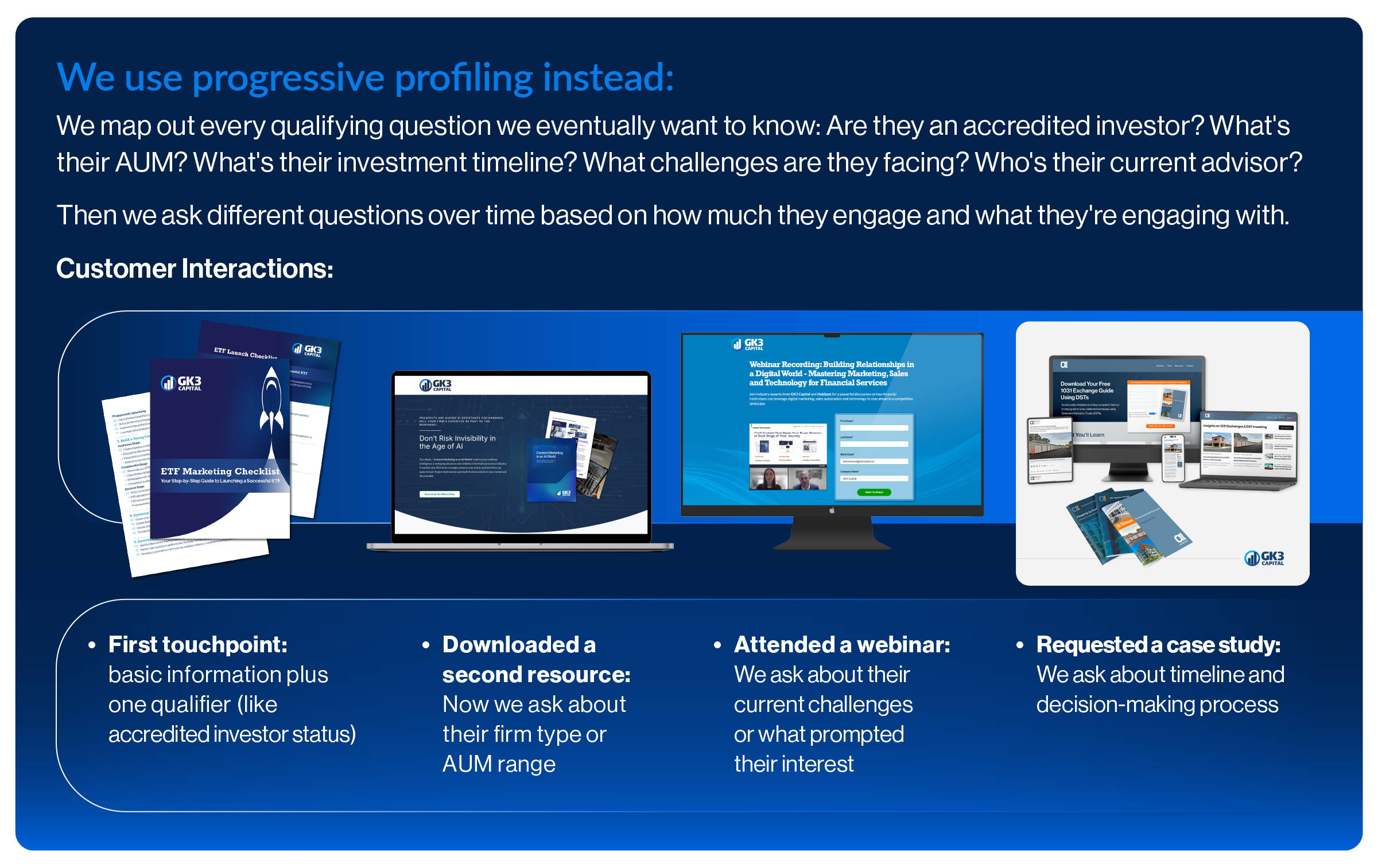 By the time they're decision-ready, we've built a robust profile without overwhelming them on day one. Each question feels relevant to what they just engaged with, not like a interrogation.
This approach respects their journey while systematically qualifying them based on demonstrated interest, not assumptions.
Pros and Cons of Journey-Based Lead Management
Pros:
- Higher conversion rates: Prospects receive relevant content that matches their actual needs and timeline
- Better lead quality: Behavioral tracking reveals true intent better than form fields
- Improved sales efficiency: Reps engage with context, not cold outreach
- Scalable personalization: Automation handles stage-appropriate nurturing while humans focus on high-intent prospects
- Reduced lead leakage: No prospects fall through the cracks because every stage has a defined path
Cons:
- Requires upfront investment: Building stage-specific sequences takes time and compliance approval
- Needs proper tracking: You must have systems that capture and report engagement behavior
- More complex than one-size-fits-all: Your team needs training to understand the playbook
- Ongoing optimization required: You'll need to refine sequences based on conversion data
What Separates Winners From Everyone Else
Over the last eight years, I've helped close to 100 financial firms implement this playbook. Some crush it. Others struggle.
The difference isn't their CRM. It's not their email copy. It's not even their offer.
The firms that win are the ones that combine fast response with relevant engagement.
The average B2B lead response time is 42 hours. If you're responding within the first hour, you've cleared the first hurdle. But that only gets you in the game.
What happens next is what matters. Are you showing up with generic sales speak, or are you demonstrating that you understand where they are and what they need right now? Are you asking questions that reveal insight about their journey, or just checking boxes on a qualification form?
Speed creates opportunity. When someone fills out a form and immediately gets a meaningful response, they feel heard. When they wait two days, they assume you're disorganized or don't care. But when they get an instant response that's clearly templated and irrelevant, they assume you're automated and impersonal.
Your playbook needs to balance both. Immediate, stage-appropriate response. Automated sequences that trigger within minutes but match where prospects are in their journey. Human follow-up that references actual engagement, not generic interest.
The firms that figure this out convert. The ones that optimize for speed alone burn through leads. The ones that wait 48 hours never get the chance.
Start With Process, Not Technology
Most firms think they need a sophisticated CRM before they can manage leads properly. They spend months evaluating platforms and configuring workflows.
That's backward.
Start with the process. Map out exactly what should happen based on what content prospects engage with and where they are in their buying journey. Define the triggers, the sequences, the handoff points between automation and humans, all tied to behavior, not arbitrary timelines.
Then find the technology that supports that process.
Frequently Asked Questions About Lead Management
How quickly should we respond to a new lead?
Within the first hour if possible. Research shows that responding within 5 minutes makes you 21 times more likely to qualify a lead compared to waiting 30 minutes. However, speed without relevance is ineffective. Your response must be appropriate for where they are in their buying journey.
Should we call, email, or text new leads?
Start with an automated, stage-appropriate response (usually email with relevant next steps). For decision-stage prospects who don't schedule within 24-48 hours, follow up with a phone call that references their specific engagement behavior.
How many fields should our lead capture forms have?
It depends on the value of your offer. A basic resource might only need first name and email. A high-value webinar or consultation can ask for more qualifying information. The key is using progressive profiling: asking different questions over time based on what they engage with, rather than overwhelming them with a long form on their first interaction.
What if we don't have the technology to track engagement behavior?
Start with the process first, technology second. Map out what should happen at each journey stage, then find tools that support that workflow. Most modern CRMs (like HubSpot) include basic behavioral tracking capabilities.
How do we get compliance approval for automated email sequences?
Submit all sequence emails to your compliance team for approval before launching. Once approved, those emails can run automatically. Build compliance review time into your playbook development timeline.
The Bottom Line: Stop Treating Every Lead the Same
The answer to "What do you do with leads once they start coming in?" is simple: respond quickly with content that matches where they are in their buying journey. Build stage-specific sequences, plan strategic human touchpoints, and use behavioral intelligence to guide your next action.
The paralysis you feel when leads start flowing (Should we call? Email? How fast is too fast?) comes from not having a process that accounts for context. Every lead becomes a debate instead of an execution.
At GK3 Capital, we work exclusively with financial services firms because we speak both languages. We understand the compliance requirements, the qualification standards, the sales cycles that span months instead of days. Over eight years, we've helped close to 100 firms implement this approach, and today we work with approximately 25 firms managing over $60 billion in assets. We know what works in your world.
If your marketing is working and leads are flowing in, the real question is whether your digital sales and marketing process is actually built to convert them. Our Digital Sales & Marketing Scorecard helps financial services firms identify where leads are getting stuck, what’s working, and what needs to be improved. In just a few minutes, you’ll uncover strengths, weaknesses, and receive actionable recommendations you can apply immediately.

