
.png?width=651&height=365&name=72675-%20GK3%20Blog%20-%20Learning%20Center%20325x155@2x%20(1).png)
Something lands in your inbox or your feed, and within two words you can tell it wants something from you. Buy from me. Book a call. Don't miss out. You brace against it before you've even read it. Most of us feel that flinch a dozen times a day and never think about it again.
I thought about it because for years I was the one causing it. And I hated the flinch too, on both ends. I just couldn't tell you why.
This was earlier in my career, running sales and marketing at a software company. I was good at it. I hit my numbers. Google Ads, Facebook ads, cold outreach, the whole push. Get in front of them, get them on the phone, get the close. It worked well enough that nobody questioned it, including me. But something about it felt wrong. Every campaign felt a little like trying to convince someone, and that someone was a person exactly like me, bracing the way I brace when it's aimed at me. I kept that to myself, because I couldn't name it, and a feeling you can't name is easy to ignore when the numbers are fine.
Here's the thing about me. I am fascinated by the why behind things. I can't leave a feeling like that alone. So it followed me around for years, this quiet sense that I was doing something slightly off, with no language to explain it.
A year in financial services marketing finally gave me the words.
I came across a framework called They Ask You Answer, by Marcus Sheridan. [1] And it did the thing I find more valuable than almost anything else. It articulated something I already believed but had never had the words for. It's almost like there's a blueprint in me I'm not fully aware of, and every so often someone says a thing and a piece of it lights up. A piece that was always there I just didn't have access to.
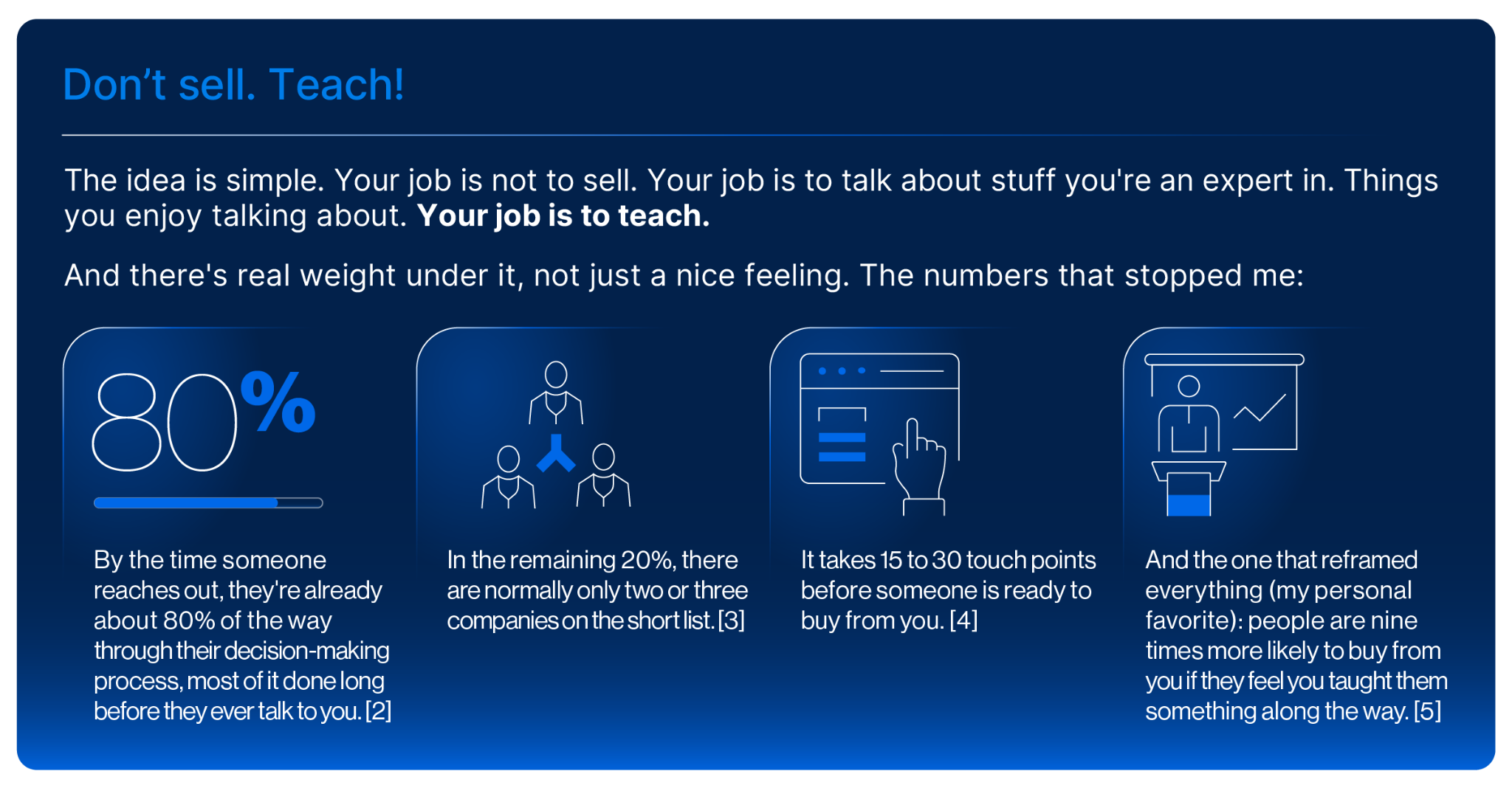
Think about the last time you needed something. Let's say you're looking to buy a new lawn mower. You don't call a guy and then hand him your money. You look it up first. You want enough footing to not get taken advantage of, enough foundation on the topic to answer the basic questions: type of mower, cost range. And you end up getting most of the way there before you ever speak to a human, and whoever taught you something useful in that stretch earned the trust that the rest never got near. That was the marketer you didn't flinch at. The one who helped you instead of closing you. You already know the difference between the two kinds of marketing, because you've been on the receiving end of both.
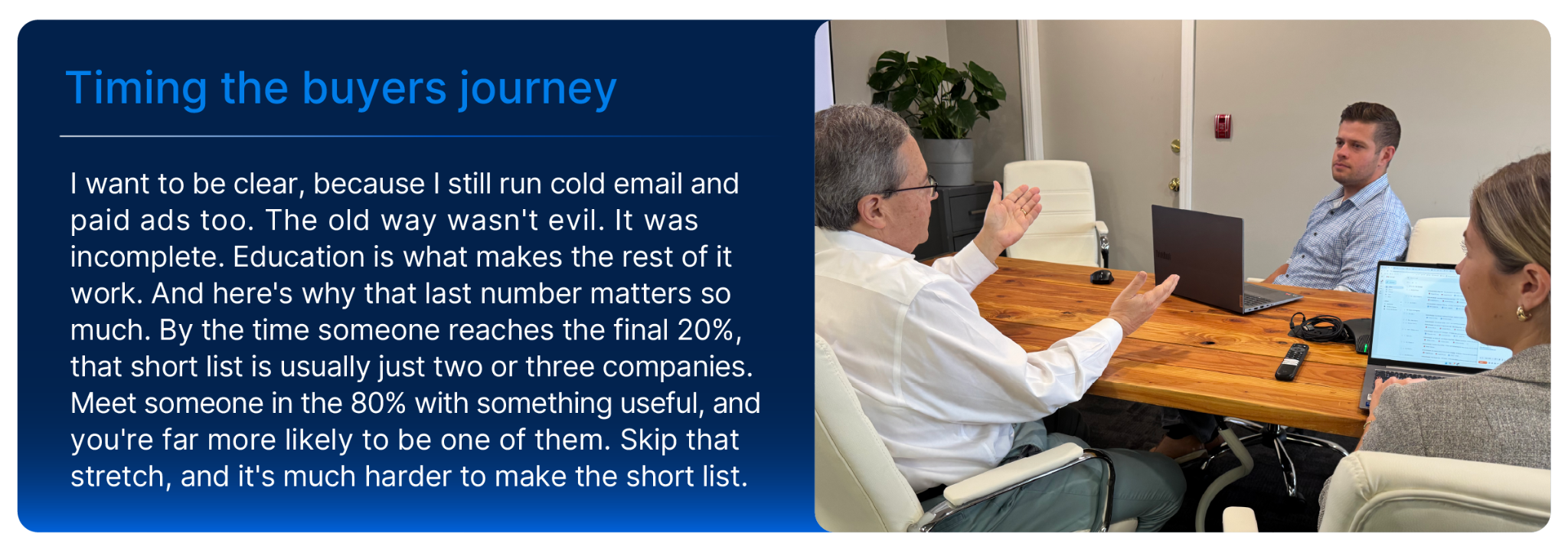
That's the part I had backwards. I used to try and meet people in the last 20%, when they were ready to spend, and wonder why it felt like trying to sell them. Because it was. Getting hit with the pitch prematurely is the flinch felt from the other side. Now I try to meet them in the 80% (the much bigger window anyway), the research, the part where they're just trying to understand. And that feels so much better, because talking and writing about things you're an expert in is enjoyable. I spend hours, weeks, years thinking through and wrestling with these concepts, or learning about them, and now I can simply share that with the people looking for it. Putting that work down on paper for someone looking for it feels way better than trying to convince people to give you their money.
So most of what I build now isn't an ad at all. It's the ebook, the factsheet, a blog (you're reading one), the honest answer to the question they're actually looking for.
But that's the mechanics, and the mechanics aren't why I love it.
I love it because I get to speak to something a person is already carrying and hand them the words for it. The same thing the They Ask You Answer framework did for me, that piece of the blueprint lighting up, is the thing I get to do for someone else.
So if you've ever felt that flinch at being sold to, and couldn't say why, here it is. Pushing a product at someone who never asked feels manipulative. Talking about the things I know best, with the people actually looking for them, feels like a human connection.
Sources
- They Ask You Answer, Marcus Sheridan.
- Buyers are roughly 80% through their decision before contacting a company: Marcus Sheridan, They Ask You Answer framework, via Petra Coach. petracoach.com/they-ask-you-answer-with-marcus-sheridan
- The final short list is usually two or three companies: TrustRadius 2026 B2B Buying Disconnect Report (published via HG Insights, July 2026), which found 83% of buyers shortlisted three or fewer products, with an average shortlist of 2.7. hginsights.com/blog/trust-more-verify-everything-what-the-2026-b2b-buying-disconnect-report-says-about-where-buying-is-actually-heading
- Buyer touchpoints before a purchase: SyncGTM, "How Many Touch Points Before a Sale? 2026 B2B Guide," which puts mid-market deals at 15 to 30 direct touches. syncgtm.com/blog/how-many-touch-points-before-a-sale
- Buyers are nine times more likely to buy when they feel educated: Marcus Sheridan, Endless Customers Live, Chicago, 2026
