

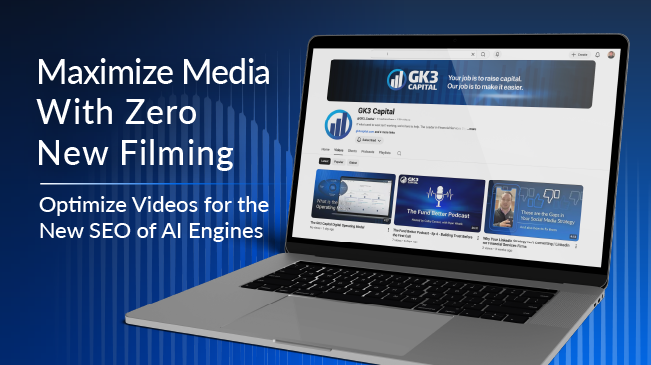
From a marketer who used to think YouTube was a waste of time for financial services firms.
Why I Changed My Mind About YouTube
We recently walked a client preparing for a US market entry through their launch strategy, and the YouTube conversation took up more of the room than I expected it to.
Their hesitation made sense. They had an existing channel in another market, mostly recorded webinars and a few executive interviews, and no real interest in becoming a video brand. The question on the table was whether to spin up a US-specific channel at all, or whether the budget and attention would be better spent somewhere else.
A year ago, I would have understood the resistance and probably softened my recommendation. Maybe a channel makes sense down the road. Focus on what's working first.
I don't give that answer anymore.
The reason isn't that more financial advisors are suddenly watching YouTube in their spare time. The reason is AI search. When an accredited investor opens ChatGPT and asks about a private fund, when an advisor uses Perplexity to research a manager, when an allocator runs a query through Google's AI Overview, the answers those tools generate pull heavily from YouTube transcripts. Not from white papers. Not from your website. From YouTube.
If your channel isn't optimized for that reality, you're not just losing views. You're losing the citation surface where buyers are forming their first impression of you.
Here's the eight-part checklist I now use when I'm walking a client through what a working channel looks like.
Before You Publish a Single Video: Channel Setup
This is the part I see most firms skip, and it's the part that quietly tanks everything that comes after. A new channel with bad setup will underperform a smaller channel that did the basics right.
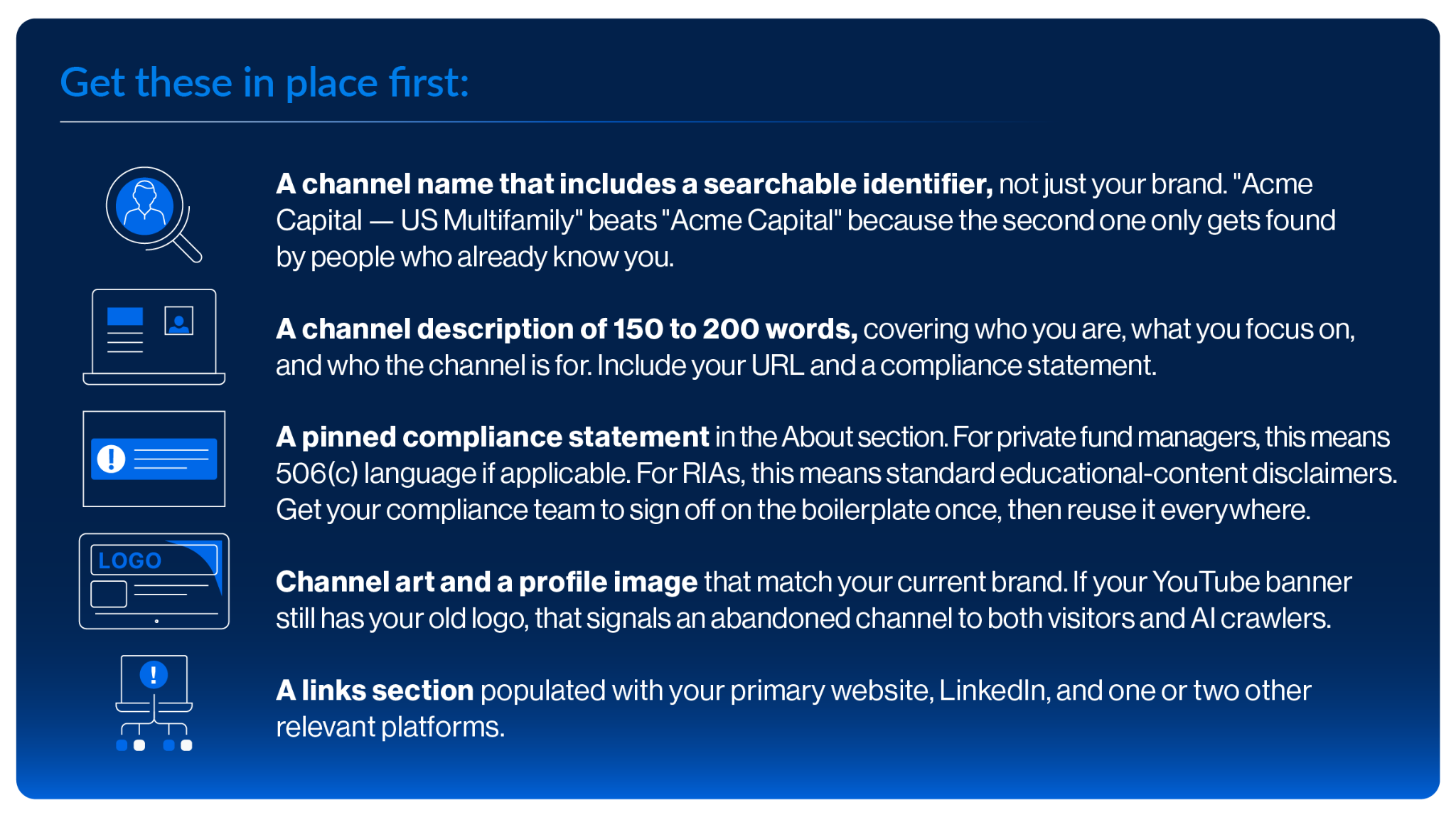
I know this part feels like housekeeping. It is. It's also the first thing AI tools read when deciding whether your channel is an authoritative source.
The 8 Optimizations I Walk Every Client Through
YouTube and AI platforms don't watch your videos. They read the text around them. The eight items below are the text signals that determine whether your content gets surfaced or buried.
I've grouped them into three categories so it's easier to prioritize: the text layer (what AI actually reads), the discoverability layer (what helps people find you), and the trust layer (what makes them click).
The Text Layer: What AI Actually Reads
- Transcripts. This is the single highest-leverage optimization available, and it's also the one I see ignored the most. It takes less than 30 minutes per video. Upload manually edited transcripts through YouTube Studio to replace the auto-generated versions. Auto-transcripts mangle financial terminology constantly- fund names, regulatory terms, market-specific language. Clean the text, add speaker labels ("Sarah Chen:", "Host:"), structure into Q&A-style sections where possible, and layer search-term keywords at the end. AI reads transcripts as plain text, which means a clean transcript is essentially a 5,000-word piece of citable content attached to every video. If you only do one thing on this list, do this.
- Video titles. Eight to twelve words, primary keyword in the first 40 characters, written as a question or specific claim. "What Is a 506(c) Offering and How Do Accredited Investors Qualify?" gets surfaced by AI. "Q3 Investor Update" does not. I review a lot of channels and I keep seeing brand-only titles on videos that deserved better. AI tools match titles to how people actually phrase queries, which means if your title doesn't sound like something an investor would ask, it won't be cited.
- Descriptions. 150 to 300 words. Open with a question your audience is already asking. Include a "what you'll learn" section with timestamped chapters. Write bullet points as direct questions. Add a presenter bio block with credentials. Close with hashtags, comma-separated tags written as full search queries, and your compliance disclosure. The description is the most machine-readable element on the page. It's also where I see the most lazy copy-paste work, which is a missed opportunity every single time.
- Chapter markers and timestamps. Add chapters to every video over three minutes. Label each chapter as a clear question or topic, not a generic header. "2:30; How does a Reg D offering differ from a public REIT?" gives AI a specific answer to extract. "Section 2" gives it nothing. Aim for four to six chapters per full-length video. This one feels small. It's not.
The Discoverability Layer
- Tags and keywords. Fifteen tags per video, 500 characters max, every tag written as a full search query rather than a single word. Mix brand-specific tags ("Acme Capital fund"), topic-specific tags ("private real estate for accredited investors"), and audience-specific tags ("passive income for high net worth investors"). Full-phrase tags match how your audience searches. They're especially important for newer channels that haven't built organic search history yet.
- Hashtags. Three to five per video, placed at the end of the description after your compliance disclosure. Mix broad tags (#PrivateRealEstate, #AccreditedInvestor) with specific ones (#SunbeltMultifamily, #506c). Hashtags improve YouTube's internal search and feed AI indexing, both of which matter when you're trying to establish topical authority from a standing start.
- Playlists. Assign every video to at least one playlist from day one. Build playlists by content type (Market Insights, Investment Education, Team and Process) and by audience (For Accredited Investors, For Financial Advisors). Write a 50 to 100 word optimized description for each playlist. One thing I'd specifically flag: don't mix educational content with anything that could be construed as fund solicitation, especially under 506(c) rules. Your compliance team will thank you.
The Trust Layer
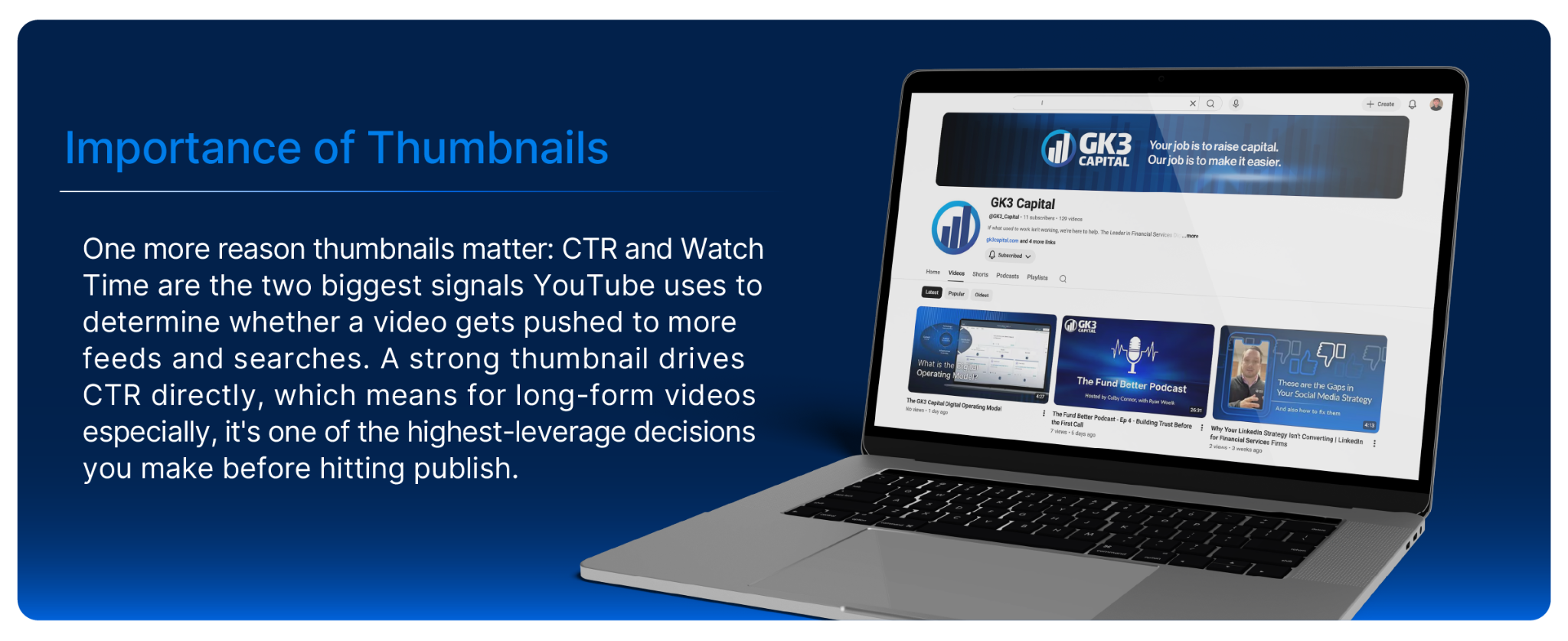
- Thumbnails. Thumbnails don't affect AI citation directly, but they determine whether anyone clicks once your content surfaces. High-contrast background, consistent font and color palette matching your current brand, prominent face or person element, and minimal text. Style consistency across videos in a series signals a unified channel identity. That matters disproportionately when you're a newer channel trying to build credibility from a standing start.
What "Done" Looks Like vs. "Live but Invisible"
Here's the version I keep running into: a live but invisible video has a 4-word title, an auto-generated transcript full of errors, a 50-word description, no chapters, no tags, no playlist assignment, and a thumbnail your intern made in Canva. It exists. It just won't get found.
A "done" video has all eight items above completed before it goes public. It also gets pinned with a compliance-aware comment directing viewers to your site for more information, and someone replies to every comment within 48 hours of upload. That 48-hour window matters more than most teams realize. Engagement signals in the first two days disproportionately influence whether YouTube's algorithm surfaces the video at all.
The other thing that separates "done" from "invisible": retroactive optimization. Every video already on your channel can be updated. New title, new description, manually edited transcript uploaded, chapters added, playlist assigned. Once the metadata changes, AI tools start re-crawling, and citations can begin generating within days. You don't need new content to start showing up. You need the content you already have to be optimized.
This is the part I tell clients first when budget is tight. Start with what you have.
Frequently Asked Questions
How long does it take to see results from YouTube optimization?
For retroactive optimization on existing videos, AI citations can start appearing within two to four weeks of metadata updates. For new content, plan on three to six months of consistent publishing to build channel authority. The compounding effect kicks in once you have 15 to 20 well-optimized videos in a clear topical area.
Do we need to publish a video every week?
Consistency matters more than frequency. A workable starting cadence is one long-form video per week plus one to two short clips cut from that video. If that's not realistic, one solid video every two weeks beats inconsistent uploads. The algorithm reads frequency signals, but it punishes abandonment more than it punishes a slower cadence.
What about compliance review timelines?
Build your YouTube workflow with compliance review baked in from the start, not bolted on at the end. Standard educational content (market commentary, "what is" videos, process explanations) moves through compliance faster than anything that mentions specific funds, performance, or returns. Lead with the educational content while you build the muscle.
Can we just hire someone to do this?
You can, and many firms should. The 30 minutes per video for transcript cleanup adds up fast across a publishing schedule. Whether you build this in-house or outsource it, the checklist above is what good looks like. Use it to evaluate whoever owns the work.
The Bottom Line
A year ago, I would have told a client to skip YouTube and focus their budget somewhere else. I don't say that anymore, and it's not because video became more important. It's because AI tools changed what video is — from a content channel into a citation surface that AI models pull from when investors are asking exactly the questions our clients are positioned to answer.
The firms that figure this out are going to have a real advantage. The ones still treating YouTube as a content graveyard will wonder, two years from now, why their competitors keep showing up in AI answers and they don't.
You probably already have video assets sitting on your channel. You probably have more in your archives. The work isn't producing more content. The work is optimizing what you have so it can actually be found.
Ready to put content to work for your firm?
Our guide, 8 Steps to Win Investors with Content, walks through the framework for building a content strategy that actually generates leads, whether you're focused on video or not. Free download, no form-fill marathon.
