
.png?width=651&height=365&name=71306%20-%20GK3%20Blog%20-%20Learning%20Center%20325x155@2x%20(2).png)
I spent real years in this industry before AI was part of the job at all. No copilots, no generation, no models sitting in the corner of every workflow. I built campaigns the long way.
Now I work alongside people early in their careers who will never have that. They will not have a single working day of their entire professional lives without AI in the room. That still stops me when I think about it. And ChatGPT launching a paid ads platform is the biggest version yet of this AI shift. So when it opened up, I wanted in early, and I wanted to see it for myself.
I Trust the Test I Ran Over the Article I Read
Here is how I operate. Research is a starting point. My own experiment is the finish line.
Here is why. Say you ask ChatGPT, Gemini, or Claude what open rate you should expect from a cold email campaign. You will get a number. The problem is that number knows nothing about your situation. It cannot account for the specific strategy and hook woven into each email, your goal, your audience, your asset type, your sending platform, your list quality, or a dozen other things that actually move the result. Therefore, it is rarely a one-to-one comparison. It is an overall average of everyone, applied to no one in particular.
So I do not take it as an answer. I take it as a hypothesis. Then I run the thing for my specific clients and watch what really happens, because that is the only data that predicts my next campaign with any consistency.
This series is me doing exactly that in public with ChatGPT paid ads, currently running across two companies in different industries. This piece is the going-in picture: what I expected, what got proven wrong, and the early best practices I picked up along the way. Part 2 will be the results.
For context on where I am coming from, I have spent more than ten years in marketing, most of it inside Google Ads, Facebook Ads, LinkedIn Ads, and other similar platforms. Before financial services, I ran marketing departments for both an e-commerce company and a software as a service company. With Google Ads being the closest comparable to ChatGPT ads, I know the incumbent well. Which is exactly why I want to start there.
What I Have Never Liked About Google Ads
Before ChatGPT ever entered the picture, I had a running list of frustrations with the platform that owns this space.
The first one is bigger than Google. Search behavior is changing. In the first four months of 2026, roughly 68% of US Google searches ended without a single click, according to SparkToro's clickstream analysis, up from about 60% in 2024. More people get their answer on the results page or from an AI and never visit anyone's website. A lot of companies I have spoken to have watched their Google paid and organic traffic plummet because of it. And until something like ChatGPT ads showed up, there was no real way to fight back on the paid traffic side. We had no choice but to watch the numbers decrease and wait.
Then there is the platform itself. Google runs an enormous amount through automation, and you get very little insight into it. Google decides when you show and when you do not, based on what it says is working. Sometimes I agree with the outcome. But we usually have no idea what the actual reasoning was, or even what decision got made. It is a black box that spends your money.
Another one, and honestly the biggest, is intent. Everyone calls Google an intent based platform, and that is true. But it tells you very little about the type of intent behind a search. You know the person wants something. You rarely know what they actually want. I will come back to this later, because it is the exact gap I’m hoping ChatGPT ads might close.
A few more, quickly. Broad versus phrase versus exact match sounds like a lever you control, but you cannot really test which one fits your needs without spending enough to prove it, which is its own kind of tax. Support is thin. And suspensions, whether it is an account, an ad group, or a keyword, often arrive with no clear explanation and no follow up.
So I went into ChatGPT ads with a question underneath all the excitement: which of these does this new platform actually fix, and which ones come along for the ride?
What I Believed Walking in
I will be honest about my process, because it is part of the story. I did not do a pile of research before logging in. I went straight into the platform and started building, because I trust hands-on time over write-ups. Feeling the thing out was the fastest way to learn what was really possible.
I had a few assumptions going in.
The biggest one, and my number one question, was structural. Is this keyword-matched like Google, or is it something else? Everything downstream hinges on that, because it determines how much control you have over when you show and to who.
I also assumed I would get planning data. The Google Ads keyword planner gives you monthly search volume for keywords, so you know before you spend time building whether a topic is worth chasing. I figured ChatGPT would offer something similar.
And I expected reporting in the same neighborhood as Google's. Detailed metrics, and above all the ability to see the actual searches I showed up for.
What Held up, and What Got Debunked
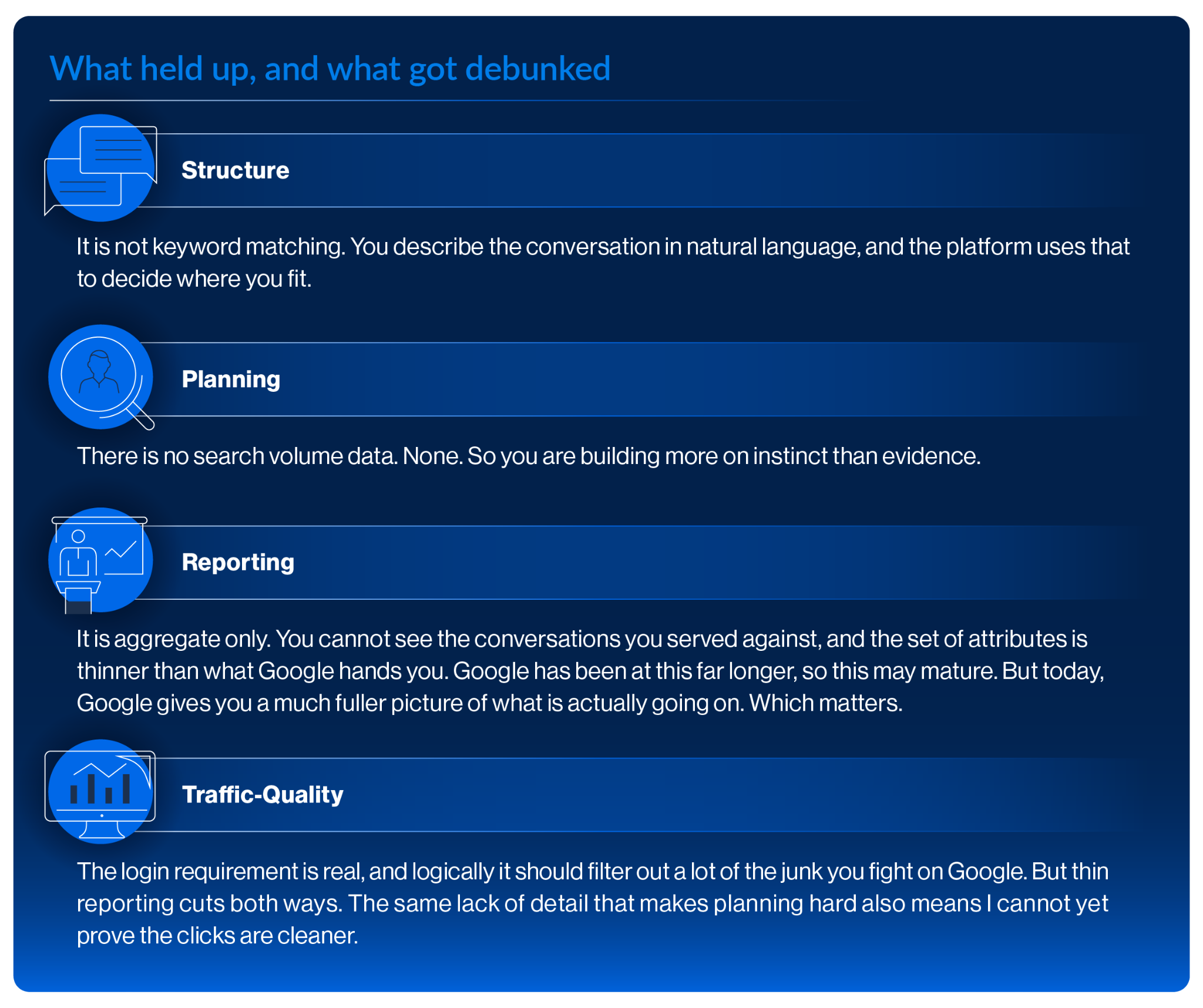
The structural question resolved in the most interesting way possible. It is not keyword matching. You describe the conversation in natural language, and the platform uses that to decide where you fit. That is the thing that got me genuinely interested, because it looks like you can at least attempt to choose the moment and the type of intent rather than a word. I am not calling it proven. That is what Part 2 is for. But as a starting point, the potential is real.
The planning assumption got debunked hard. There is no search volume data. None. So you are building more on instinct than evidence. That campaign I just spent hours creating might be sitting on top of real demand, or it might not, and right now I cannot tell you which before it runs. If there is a tool out there for this beyond awkwardly borrowing Google's keyword volume as a proxy, I am not aware of it. This is a genuine hesitation of mine.
Reporting got debunked too. It is aggregate only. You cannot see the conversations you served against, and the set of attributes is thinner than what Google hands you. Google has been at this far longer, so this may mature. But today, Google gives you a much fuller picture of what is actually going on. Which matters. When you can see the exact phrases you showed up for on Google, you can adjust your ad copy, refine your website copy, build relevant landing pages, better choose the topics for your written content, and more, all based on that information. Just seeing what people actually search lets you build around demand you know is there. That is a foundation ChatGPT is not providing at the moment.
So the scorecard so far. The shrinking-click problem is a main reason this channel is exciting, because it gives you back control over when you show on the platform where attention is moving, in a way organic AI results do not. The automation black box is arguably worse here, since you have even less visibility. And for someone who builds his whole read of reality off reports, losing the planning and reporting depth I leaned on with Google stings.
Intent Versus the Type of Intent
Here is the idea I keep coming back to, and the reason I had to remind myself several times throughout this not to get too excited too early.
People call Google an intent-based platform, which is true. But the type of intent is the part that always gets passed over. If I search "lawn mower" on Google, there is obviously intent behind it. I am clearly after something lawn mower related. But am I buying a mower, hunting for a replacement part, or just spell-checking whether it is one word or two? Yes, there is intent, but we have no real idea what it actually is.
The obvious pushback here is exact match. Any real marketer will point out that Google lets you target a specific phrase, so why not just target "I am looking to buy a lawn mower" and capture the exact intent? The problem is volume. The average Google search is about four words long, according to Semrush. So the moment you target a long, specific phrase on exact match, your volume collapses to almost nothing. Almost nobody types a full sentence into Google.
ChatGPT is different, and this is the part that matters. The average ChatGPT prompt runs around twenty-three words, again per Semrush. People treat it like a conversation, not a search box, so they hand it far more context about what they are actually trying to do. That extra context is exactly what we can target against. We can attempt to write the intent into the ad group description itself, because ChatGPT will know it. Something like: "get this in front of people looking to purchase a new lawnmower." Yes, ChatGPT can run with that in several directions. But it at least has the potential to pinpoint not just intent, but the specific type of intent, which is something you cannot practically do on Google Ads.
And it is not only about what someone wants. It is about who they are. Go back to the lawn mower search. Even if I somehow know the intent is to buy, I still have no idea who is doing the searching. A homeowner ready to purchase? A lawn mower company employee checking on a competitor? A student writing a paper? On Google, you are guessing at the person as much as the intent.
That distinction matters enormously for us. Almost all of our clients want to get in front of registered investment advisers. Most of them do not want to show up for retail investors nearly as much. But when someone types "private real estate fund" into Google, there is no signal telling you which one you are looking at. You show for both audiences, and you pay for both.
With ChatGPT ads, you can write the audience into the ad group description the same way you write the intent. For example:
"Show this ad when registered investment advisers are researching private real estate funds…"
You can tell ChatGPT who it is you are trying to get in front of at the ad group level, and then tailor the specific verbiage to those groups. Each group may have its own pain points, proof points, and even phrasing they tend to use.
And when you can tailor the messaging more precisely, speaking more directly to whoever is reading it, engagement rates almost always improve.
That is the whole thesis in one line. On Google, you match a word and guess the headspace. Here (hopefully) you get to describe the headspace and let the platform find it.
In some ways, with the possibility of better persona and intent targeting, this feels less like marketing and more like a service. We are not interrupting someone. We are identifying people who are looking for something right now and putting the answer in front of them at the exact moment they want it.
The Honest Objection: Who is Actually Seeing These Ads
Now the part I have to be straight about, because it is the biggest question mark hanging over my head.
At this time, ads only serve to people on ChatGPT's free and Go tiers. Anyone on Plus, Pro, Team, Business, or Enterprise never sees them (yet). And the analysts covering this are already flagging that the ad-supported pool skews younger and earlier in their careers, while the most sophisticated, higher-income users tend to sit on the paid, ad-free tiers.
Both of the companies I am running this for right now are chasing the same kind of buyer, even though they sit in different industries. Here are the prospects my clients are actually after: Registers investment advisers, family offices, accredited investors, wealth and marketing decision-makers. The kind of businesses and professionals who tend to need the added features of the paid tiers. On paper, that is close to the worst-fit audience I could have picked. On its face, claiming to still be optimistic about this sounds a little crazy, so let me explain.
I am, in fact, still cautiously optimistic, and here is my reasoning, offered as my read rather than settled fact.
Say 90% of the people I want are on paid plans, and honestly I think that is an overestimation. That still leaves 10%. On a platform this size, 10% is not a rounding error. It can be tens or even hundreds of thousands of the exact people I am trying to reach.
There is also a behavior most of these estimates miss. Plenty of paid-tier users are not logged into their paid account everywhere. I currently run a paid work account on my laptop, but on my phone I just have the free app, not tied to my work login, and I use the phone version constantly for work questions. Multiply that habit across a whole profession and the free-tier pool is not as clean a demographic story as it looks.
And then there is the decision I made because of all this. ChatGPT ads gives you two bidding objectives when you set up an ad: Clicks or Reach. Straight from OpenAI's own documentation: "Reach optimizes for impressions and charges per thousand, while Clicks optimizes for clicks and charges per valid click."
I chose the Clicks objective, not Reach. Running Clicks means a poorly matched pool costs me nothing until someone actually clicks. If the intent targeting is doing its job, I am mostly paying for qualified clicks no matter how the overall pool skews. It does not solve the mismatch, because the right people still have to be in the pool to click at all. But it means I am not funding awareness to an audience I never wanted.
This will also depend on your goal. Are you looking for people ready to buy a lawnmower, or are you going for more of a brand awareness touch-point play?
The Real Experiment: What Lens Does This Platform Belong in
Here is a mental model I already trust. I (and many people I have worked with over the years) think of Facebook ads as a brand awareness play. People are not there to jump from a doom scroll back into work, so we treat it as a way to add touch points with prospects, and we do not expect bottom-of-funnel conversions from it. That framing is proven for us. It tells us when to use the platform and what to expect.
We do not have that lens for ChatGPT ads yet. And figuring it out is the main reason I am running this at all, across more than one company at once so I am not mistaking a single account for the whole story.
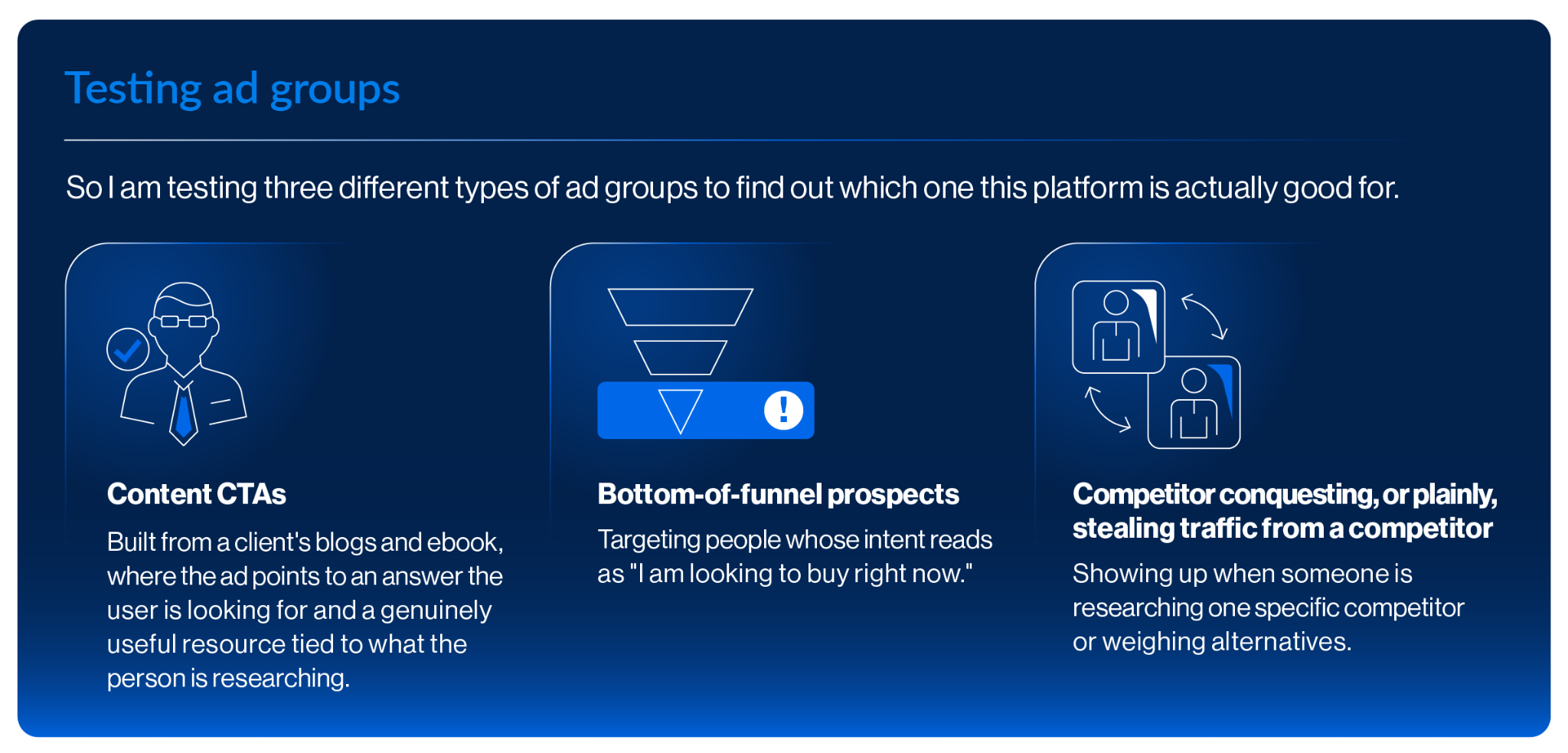 The question I am answering is simple to state and hard to know: which of these should be the lens we view this whole platform through? Is it a content and awareness channel, a bottom-funnel capture channel, a traffic-stealing channel, or something I do not have a name for yet? That is my experiment.
Best Practices I Picked up Along the Way
A few things I learned by doing, not by reading.
I ran this in two stages. Stage one was two ad groups built purely to learn the interface, understand the fields, and see what was possible. I let those run for about two weeks. I want to be clear that this stage was about learning the platform, not about findings. Stage two, the real strategic build, went live the morning I am writing this.
Then the scars. Adding the term AUM to an ad title got one of my ad groups rejected. Twice. We removed that single term, changed nothing else, and it was approved. If a term as ordinary as "assets under management" trips the review filter, that tells you this platform's approval logic is its own animal, and financial marketers should expect surprises. Watch your language and be ready to iterate.
For writing the ad group description itself, five things belong in it:
- Who you are trying to reach
- What the user is trying to accomplish
- The problem the user is researching
- The solution you provide
- The natural industry language they would actually use
Here is an actual example of one of our ad group descriptions:
"Show this ad when asset managers or financial services marketers are researching Google Ads match types, are trying to fix a lead quality versus lead volume problem, or are learning how keyword targeting affects cost per lead in paid search. Relevant topics include broad vs phrase vs exact match, negative keywords, search terms report, lead quality vs lead volume, cost per click for asset management keywords, and paid search targeting for financial advisors. GK3 helps financial services firms fix the lead quality problem at the source, in the campaign itself."
It reads like a plain-English targeting brief, not a keyword list.
Cohesion is the quiet make-or-break. Four layers have to speak the same language: the ad group description, the ad title, the ad description, and the landing page. Break any one of those connections and the person feels the disconnect immediately, and you lose them.
And the hard specs, so you do not learn them the annoying way.
- Ad title maxes at 50 characters.
- Ad description at 100 characters.
- The image is 1:1, up to 1200 by 1200 pixels, JPG or PNG, 5MB max.
- Minimum budget: 25 dollars per day per campaign.
Where This Leaves Us
That is the going-in picture. The frustrations that made me want this to exist, the assumptions I carried in, the ones that got proven wrong, the real hesitations, and some working best practices.
The experiment is live now. Whether ChatGPT paid ads turn out to be a content channel, a traffic-stealing channel, a bottom-funnel machine, or a disappointment, I would rather find out by running it than by guessing at it.
Part 2 is the receipts.
Frequently Asked Questions
Is ChatGPT Ads keyword-based like Google Ads?
No. Instead of matching keywords, you describe the conversation you want to show up in using natural language. The platform reads that description and decides where your ad fits. It's a real structural difference from how Google Ads works.
Does ChatGPT Ads offer search volume data like Google's Keyword Planner?
Not currently. There's no way to check demand before you build a campaign, so you're working more on instinct than evidence at this stage. This is one of the bigger gaps compared to Google.
What kind of reporting do you get with ChatGPT Ads?
Reporting is aggregate only right now. You can't see the specific conversations your ad served against, and the data set is thinner than what Google Ads provides. That makes it harder to refine ad copy or landing pages based on real search behavior.
Who actually sees ChatGPT ads?
Only users on the free and Go tiers see ads. Anyone on Plus, Pro, Team, Business, or Enterprise doesn't see them yet. For firms targeting RIAs, family offices, or other high-income professionals, that's a real limitation worth factoring into strategy.
Should you bid on Clicks or Reach with ChatGPT Ads?
For a mismatched or uncertain audience, Clicks tends to make more sense. You pay per valid click rather than per thousand impressions, so a poorly matched pool costs less if your intent targeting is doing its job.
What should go into a ChatGPT Ads group description?
Five things: who you're trying to reach, what they're trying to accomplish, the problem they're researching, the solution you provide, and the natural language they'd actually use. It should read like a targeting brief, not a keyword list.
What are the technical specs for ChatGPT Ads?
Ad titles max out at 50 characters, descriptions at 100 characters. Images need to be 1:1, up to 1200x1200 pixels, JPG or PNG, under 5MB. Minimum daily budget is $25 per campaign.
Is ChatGPT Ads better for brand awareness, bottom-of-funnel conversions, or something else?
That's still being tested. The experiment behind this article is running three ad group types at once (content CTAs, bottom-of-funnel prospects, and competitor conquesting) to figure out which lens fits the platform best. Part 2 covers the results.
.png?width=830&height=277&name=56029%20GK3%20CTA%20Content%20Mkting%20in%20an%20AI%20World%20v1%20(1).png)
