


I Was the Last Person Who Should Be Writing This Article
If you had told me two years ago that AI would become my number one work resource, I would have laughed. And then probably complained about it to a colleague.
The conversation about AI tools for financial services marketing and sales teams is everywhere right now. Conferences, LinkedIn, your personal social feeds. It's gone from overwhelming to feeling like background noise. A sea of AI hype that all starts to sound the same.
I get it. Because I was that skeptic.
When I first started using ChatGPT, the output was rough. It felt like a yes machine that required so much back-and-forth input that I figured I might as well just write the thing or do the task myself. I'm also, historically, not someone who warms to new technology quickly. I like what I know. I resist the glitches, the constant updates, the feeling that right when I get a grip on something, it has already changed.
My boss, John Gulino, had a very different view. He was pushing our team to adopt AI to create efficiencies and strengthen our service offerings. As a leader at GK3, he was pushing me to be a model for the team. The truth is, I wasn't. I was one of the critics.
I attended the Endless Customers conference in Chicago. Marcus Sheridan said something that stopped me cold. He said the early criticism of AI was like laughing at a seed because it wasn't a tree yet.
That was me. Exactly me.
After a year of genuinely committing to AI, mostly pushed there by John, I can say it's changed how I work, the quality of the work I produce for my clients, and the work my client’s are able to produce themselves. But here's the thing I had to learn first:

Not all AI tools are created equal. They have different strengths. Using the right tool for the right task is what actually moves the needle. Here's what I've found works.
1. MarketVoice AI: My Client Content Champion
Is there a better AI content tool built specifically for financial services?
Full disclosure: MarketVoice AI is a GK3 proprietary tool. I debated leaving it off this list entirely. But that felt dishonest, it's genuinely part of how I work every day, and leaving it out would do you a disservice. You know what you're reading now. Weigh it however you'd like.
What is MarketVoice AI? A purpose-built content platform for financial services firms that embeds your investment philosophy, brand voice, and compliance requirements before producing a single piece of content. Unlike general-purpose AI tools, it doesn't start from scratch each session.
The Problem It Solves
Every asset management firm has people inside it who think differently about markets, investing, and client outcomes than their competitors do. That differentiated thinking is their most valuable marketing asset. Almost none of them are using it.
It's not that these firms lack ideas or expertise. The problem is that turning genuine investment insight into consistent, compelling content is hard without the right system. Insights stay trapped in investment committee meetings, internal emails, and portfolio manager heads. They never make it to the channel.
Why Generic AI Makes It Worse
The natural response is to try a general-purpose AI tool. That solves the wrong problem. Here's why:
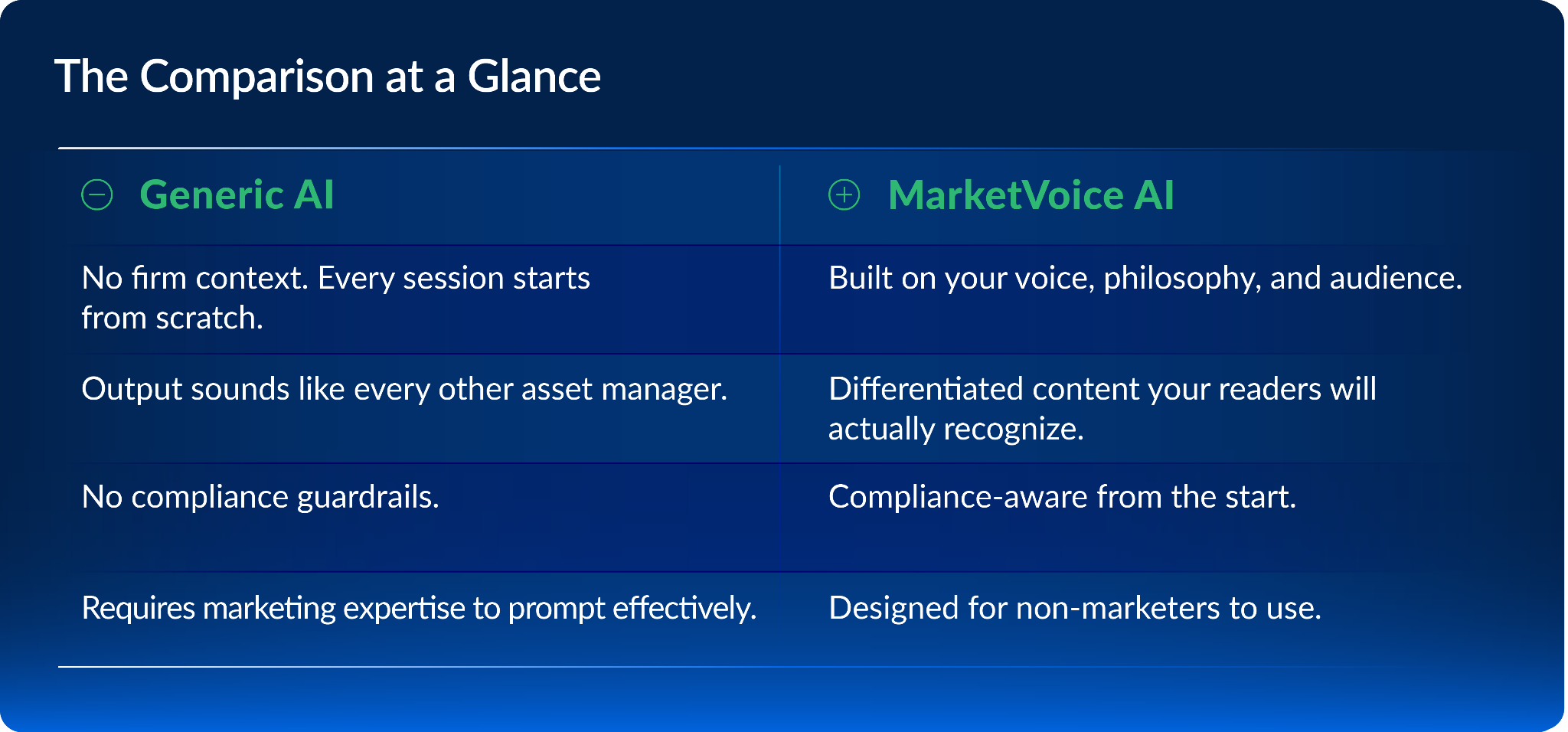
What MarketVoice Actually Is
MarketVoice AI combines artificial intelligence with a structured onboarding process that embeds your firm's voice, investment philosophy, compliance requirements, brand messaging, and audience context into the platform before you ever create a single piece of content. Unlike generic AI tools that start from zero, MarketVoice gets smarter the more your team uses it.
The result is a content engine that runs on your expertise, produces content your audience will actually read, and stays within the compliance framework your firm requires.
A Real Example: Tortoise Capital Advisors
Tortoise Capital has four portfolio managers with deep expertise and genuine opinions about the markets they cover. The challenge was getting that expertise out of their heads and into content advisors and allocators could actually find, without pulling portfolio managers away from their primary job.
Each portfolio manager now receives one interview request per month. The interview takes 10 to 15 minutes. That's the full ask. From those four monthly interviews, MarketVoice produces two to three weekly blog posts and four to five social media posts; all in Tortoise's voice, all formatted to their compliance requirements, all ready to review and publish.
The content cycle compressed from several months (idea to compliance approval) down to days. The program has driven hundreds of content downloads, thousands of website views, and hundreds of millions in AUM influenced through content-driven distribution.
Honest context: These results reflect the full GK3 engagement, including content distribution, social amplification, and campaign strategy. MarketVoice handles the content creation side of that equation. Without the content engine, none of the distribution work produces results. But MarketVoice alone isn't the whole picture.
Who It's Not For
Being honest about this matters:
-
Firms with no leadership appetite for content. MarketVoice requires executive buy-in. If the CIO thinks marketing is a waste of time, no tool changes that.
-
Firms expecting the platform to run on autopilot. The interview process requires 10 to 15 minutes per contributor per month at minimum. Truly passive firms won't see results.
-
Firms with multi-week compliance review cycles that can't be compressed. MarketVoice dramatically shortens the content creation timeline, but it can't override a compliance process that takes four weeks regardless of what's submitted.
2. ChatGPT: My Research Assistant
Is ChatGPT actually useful for financial services marketing and sales teams?
ChatGPT and I have had a complicated relationship. This was the platform I was laughing at for not being a tree yet. The early output was rough and the writing style still tends to sound like a robot wrote it, which I'll get to.
But here's how my use of ChatGPT has evolved: I use it the way I used to use Google Search. It's a research tool to help me learn.
I don't come from a financial services background. I've worked in this industry for four years and I learn something new every single day. ChatGPT has made that easier. Let me give you a recent example.
Our team at GK3 is currently going through the process of getting SIE certified. I went to school for English. This is not my wheelhouse. The study platform we're using is designed for people who already have a baseline understanding of financial services. I'd hit content like this:
"Options are derivative securities, meaning their value is derived from price changes in an underlying asset. The underlying asset could be a stock, an index, a currency, or a commodity..."
I was lost by the first sentence.
I pasted that same content into ChatGPT and asked it to explain options to someone with no financial services background. Here's what it gave me:
An option is a contract that gives you a choice. Specifically, it gives you the right (but not the obligation) to buy or sell something at a set price. Think of it like putting a hold on a price.
Imagine this: You see a house you like listed at $500,000, but you're not ready to buy yet. So you pay the seller $5,000 for an agreement: 'I have the right to buy this house for $500,000 anytime in the next 3 months.' That agreement is basically an option.
If the house rises to $600,000, your agreement is super valuable. If it drops to $450,000, you walk away and lose the $5,000.
That made sense to me immediately.
Chat is my everyday research assistant. It's what Google used to be for me, except better, because I'm having a conversation with the tool instead of sorting through search results for what's relevant. It meets me where I am and explains things in a way that actually lands.
Where ChatGPT Falls Short
Two real limitations for this audience:
The writing output is robotic. Anything I've written in ChatGPT comes out sounding like an AI article, even when I've built custom GPTs for it. I've tried to make it work for content creation and it falls short compared to MarketVoice AI or Claude. For writing, it's not my first call.
Don't use it to generate source citations. ChatGPT hallucinates sources. For financial services, where regulatory scrutiny is intense and inaccurate sourcing can come with serious consequences, this isn't a minor inconvenience. It's a real risk. For fact-checking and source verification, Perplexity AI is a better tool (more on that below).
Best For
If you're a marketer who needs to understand complex financial concepts quickly so you can produce better work for your clients and your firm, ChatGPT is your tool. It's a curiosity engine, not a content machine.
3. Claude: My Work Bestie
Can you build a custom AI tool for your financial services team?
Here's my honest take on Claude: it needs to be architected correctly to be useful. But when it is, it's one of the strongest tools in your stack.
A while back, John Gulino started experimenting with Claude for our team. In true John Gulino fashion, he spent an entire weekend building out custom projects for the things our team does every day. This was not a small lift. He spent that weekend teaching Claude about GK3, our clients, our service offerings, and our business philosophy rooted in the They Ask You Answer approach by Marcus Sheridan.
The same person who spent a year pushing me toward AI also spent a weekend building the system that finally made me a believer in it. Here's what we have today:
- A website auditor
- A buyer persona generator
- A content strategy producer
- A 5 P's developer
- A landing page builder
- A paid media planner
- A proposal wizard
The list goes on and on. But these are purpose-built tools, all operating inside Claude with the full context of how GK3 works. I use the proposal wizard daily. Before it existed, building a custom proposal for a client was a multi-hour manual process. Now I upload a call transcript, talk through my thinking, and Claude builds a proposal-ready document with actual numbers and strategies, grounded in everything it already knows about our pricing and approach.
The paid media planner was the same story. Hours of manual work compressed into something I can actually run with a client on a tight timeline.
How This Applies to Your Firm
With the right architecture, your team could build something similar. Marketers could use a Claude project trained on your firm's brand standards, compliance rules, and content strategy to review whether marketing materials are actually doing the job, not just passing compliance, but working as marketing. A portfolio manager could use it to develop a campaign around a new fund launch.
One strong use case worth calling out specifically: teaching Claude your compliance rules to create a compliance checker that all content runs through before it goes anywhere near your review team. That alone could compress review cycles meaningfully.
The Honest Limitation
Claude requires a real investment of time upfront. Like most AI tools, it works best when someone has dedicated time to teaching it the foundations of the business, the philosophy, the branding, the compliance requirements. The GK3 build John did over a weekend was not a casual exercise.
If no one on your team has the time or interest to build that architecture, Claude cold is a much less useful tool. It's not something you get full value from by signing up and jumping in.
Best For
Marketing and sales teams in the financial service industry, but only with proper setup. The upfront investment is real. The payoff for teams that commit to it is significant.
Honorable Mention: Perplexity AI
Should financial services teams use Perplexity AI for research?
I don't use Perplexity daily, so I'm not going to review it as if I do. But our content team does, and I'd be doing you a disservice not mentioning it here.
For financial services teams where regulatory accuracy is non-negotiable, Perplexity is worth exploring. Unlike ChatGPT, it's designed specifically to cite sources, which means the research it produces is verifiable. For a space where inaccurate data can carry serious regulatory consequences, that distinction matters.
The Bottom Line
A year ago, I thought AI was mostly noise. Today it's genuinely how I work. But the shift wasn't about the tools themselves; it was about changing what I expected from them.
AI isn't going to replace the human element in financial services marketing and sales. It doesn't understand your clients the way you do. It can't build the trust your wholesalers have with advisors. What it can do is take the manual, time-consuming work off your plate so you can spend more time on the things only you can do.
The firms that figure that out are going to have a real advantage. The ones still waiting for AI to be a finished tree before they plant the seed will be playing catch-up.
Frequently Asked Questions
What are the best AI tools for financial services marketing teams?
The most useful AI tools for financial services marketing teams right now are purpose-built content platforms like MarketVoice AI, general research tools like ChatGPT, and customizable work tools like Claude. The right choice depends on what problem you're trying to solve. For content creation with compliance guardrails, a purpose-built platform wins. For research and concept explanation, ChatGPT works well. For building custom workflows across multiple marketing tasks, Claude, with proper architecture, is hard to beat.
Is ChatGPT safe to use for financial services content?
ChatGPT is useful for research and learning, but carries real risk if used for sourcing or compliance-sensitive content. It has a known tendency to hallucinate sources, meaning it can generate plausible-sounding citations that don't exist. For financial services teams operating under FINRA and SEC scrutiny, unverified sourcing is a serious liability. Use ChatGPT to understand concepts. Use a dedicated tool like Perplexity AI when source accuracy matters.
Can AI tools handle financial services compliance requirements?
General-purpose AI tools like ChatGPT and Claude do not have built-in awareness of FINRA Rule 2210, SEC Marketing Rule requirements, or your firm's specific disclosure language. They can be taught compliance rules through careful architecture, but that requires intentional setup. Purpose-built platforms like MarketVoice AI are designed with financial services compliance frameworks embedded from the start, which is a meaningful difference for asset managers producing content at scale.
How long does it take to set up Claude for a financial services team?
A meaningful Claude setup, one that actually reflects your firm's voice, compliance requirements, and workflows, requires a real time investment upfront. The GK3 build took a dedicated weekend to architect properly. For firms without someone willing to invest that time, Claude out of the box is a much less powerful tool. The payoff for teams that commit to it is significant, but it's not a plug-and-play solution.
Do financial services firms actually need AI tools, or is this just hype?
The hype is real, but so is the underlying shift. Advisors and allocators increasingly find managers through digital channels. Firms that produce consistent, intelligent content build credibility over time. AI tools don't replace the human expertise and relationships that drive financial services businesses, but they do remove a lot of the manual friction that keeps good ideas trapped inside firms instead of reaching the market. The question isn't whether AI is worth exploring. It's which tools are worth your time.
