

Content is the one thing that's never done. There's always another post, another email, another something due, and after enough cycles it starts to feel like you're just filling space to keep the machine running. Then AI showed up and made it even easier to churn out more of the same, which is exactly the problem. This blog is strictly new-to-the-industry actionable items, accumulated from industry experts, the kind of thing that helps your content actually stand out instead of adding to the noise.
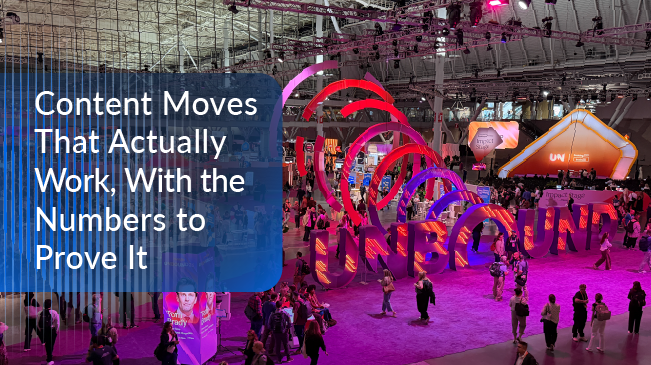
Quick context if this is the first piece of mine you've read: I've spent 10+ years in marketing, in different industries, and I just got back from Unbound 2026, HubSpot's annual marketing conference, where these findings come from. This is the third and final post in my series of takeaways, the first covered AI visibility (AEO), the second covered email, and this one is about the content itself.
Nearly every item below is backed by real experiment data, not general "best practices," and I've included the stats and the source on each so you know it's worth your time before you invest any. Let's start with my favorite, because you can act on it the second you finish reading.
Which words are proven to hurt?
The overused, "AI-sounding" ones, and Jay Schwedelson put hard numbers on exactly what they cost you. When these words show up in the first three words of a subject line, title, or headline, engagement drops, and it drops across every channel. Here's the full list, with the measured drop for each word across five different formats:
|
# |
Word |
Email Open Rate |
Podcast Title Plays |
Webinar Title Registrations |
Landing Page Sign Ups |
Social Post Engagement |
|
1 |
unlock |
-18% |
-20% |
-26% |
-24% |
-17% |
|
2 |
discover |
-16% |
-17% |
-24% |
-21% |
-15% |
|
3 |
revolutionary |
-22% |
-25% |
-31% |
-28% |
-20% |
|
4 |
game-changing |
-24% |
-27% |
-33% |
-29% |
-22% |
|
5 |
next generation |
-20% |
-22% |
-28% |
-25% |
-19% |
|
6 |
cutting edge |
-19% |
-21% |
-27% |
-24% |
-18% |
|
7 |
leverage |
-17% |
-19% |
-26% |
-23% |
-16% |
|
8 |
harness |
-16% |
-18% |
-24% |
-22% |
-15% |
|
9 |
maximize |
-18% |
-20% |
-27% |
-24% |
-17% |
|
10 |
optimize |
-17% |
-19% |
-26% |
-23% |
-16% |
|
11 |
streamline |
-15% |
-17% |
-23% |
-21% |
-14% |
|
12 |
effortless |
-21% |
-24% |
-29% |
-26% |
-19% |
|
13 |
powerful |
-14% |
-16% |
-22% |
-20% |
-13% |
|
14 |
innovative |
-18% |
-21% |
-27% |
-25% |
-17% |
|
15 |
seamless |
-16% |
-18% |
-24% |
-22% |
-15% |
|
16 |
transform |
-19% |
-22% |
-28% |
-25% |
-18% |
|
17 |
elevate |
-17% |
-19% |
-25% |
-22% |
-16% |
|
18 |
ultimate |
-15% |
-17% |
-22% |
-20% |
-14% |
|
19 |
exclusive |
-13% |
-15% |
-20% |
-18% |
-12% |
|
20 |
limited time |
-12% |
-14% |
-19% |
-17% |
-11% |
(Source: Jay Schwedelson / Worldata Research.)
Why it matters: This is your instant win. Pull up anything you're about to publish and check the first three words against this list. The damage is worst on webinar titles, where "game-changing" drops registrations 33%, but it hurts everywhere and it's an easy fix. In an internet flooded with AI copy, these words are a tell, and the reader (consciously or not) tunes out.
How do you make content feel human when AI can write anything?
Add the things AI still can't fake. This was the natural follow-up to the word list, and it's the deeper version of the same idea. It's not enough to delete the robotic words, you have to replace them with markers of a real person. The recipe shared at the event:
one specific observation,
one opinion someone could actually disagree with,
one oddly precise detail
one sentence under six words.
Why it matters: Generic is the default setting of AI, so generic now reads as "machine." Specificity and a genuine point of view are the hardest things for a model to imitate, which is exactly why they signal a human wrote this. It's a concrete recipe, not the vague advice to "be authentic" that never tells you what to actually do.
What content format does AI cite and share the most?
Best-of and listicle content, by a wide margin. I covered this in the AEO post from the "getting cited" angle, but it belongs here too, because it's a content-creation decision before it's an optimization one. When you're choosing what to make, the format itself changes how far it travels. Listicles get cited by AI roughly 3x more than an average page, with how-to guides, original research, and comparison pieces close behind.
Why it matters: Most of us pick a format out of habit. This is a reason to pick it on purpose. If two ideas are equally good, the one you build as a structured list or a clear how-to has a real, measurable edge in getting picked up, by AI and by readers who scan. (Source: independent academic study, Kumar et al., "Generative Engine Optimization at Scale," arXiv 2026.)
How do you get more content without creating more from scratch?
Turn one piece into many. This one came from Daniel Disney (one of LinkedIn's most-followed voices), and it's the highest-leverage habit on this list. A single good post doesn't have to be a single post. Take one that worked and reshape it: a poll becomes a stat post, becomes a short article, becomes a video, becomes a quote graphic. Same core idea, several formats, a fraction of the effort of starting over each time.
Why it matters: Most teams are on a treadmill of always making the next new thing, while their best ideas get used once and abandoned. Atomizing lets you wring full value out of what already worked, and it feeds the "show up consistently across platforms" signal that both audiences and AI reward. Your best-performing post is raw material, not a finished product.
What should you actually post? (10 ideas that aren't just promotion)
When you're staring at a blank calendar, this is a cheat sheet. Also from Daniel Disney, a menu of 10 content types that give value instead of just selling:
- Behind the scenes: show what happens behind the curtain and humanize the brand
- Meet the team: put faces to the name
- Expert interviews: share conversations with people worth hearing from
- Industry insights: trends and analysis that educate
- Industry humour: entertain and relate (use with care in regulated spaces)
- Data and statistics: share numbers that inform and add credibility
- Tips and how-tos: practical advice people can use right away
- Polls: ask questions that spark conversation
- Motivation: mindset and success stories
- Book or podcast reviews: takeaways and recommendations
Why it matters: The fastest way to kill an audience is to make every post an ad. This list keeps a feed varied and worth following, and it doubles as a rescue when you're out of ideas. Rotate through it deliberately rather than defaulting to the same one or two types you always reach for.
Which video format has the highest completion rates?
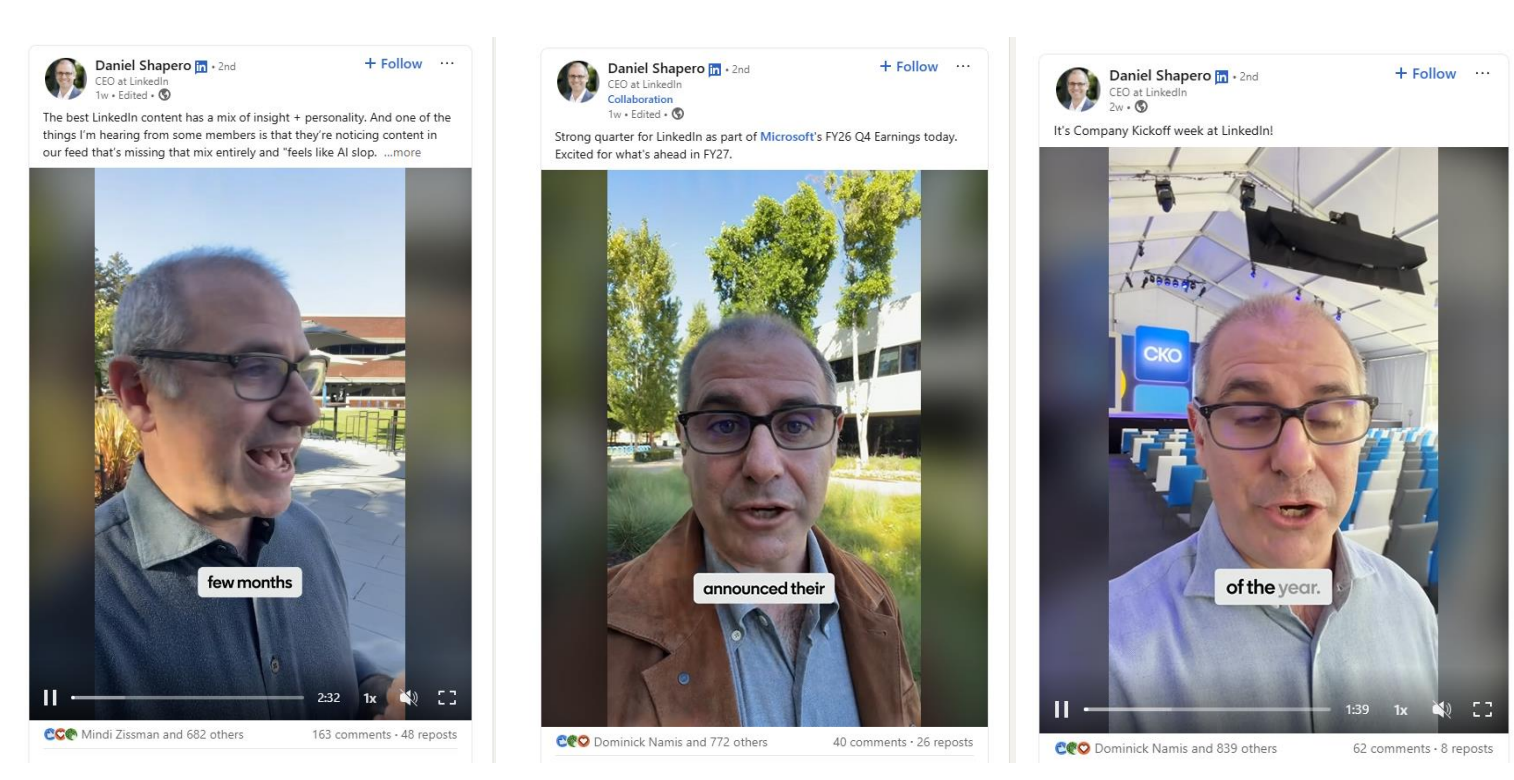
Walk-and-talk, and it's not close. Of everything in this post, this stat surprised me most. Video where the presenter talks to the camera while walking (as opposed to a static, seated talking head) gets a 49% higher finish rate.
You don't have to look far for proof of concept. Daniel Shapero, the CEO of LinkedIn, posts exactly these, walking through campus, talking to the camera, captions on. It speaks volumes if the person in charge of the algorithm is doing it.
Why it matters: Finish rate is what platforms reward, so a video people actually watch to the end gets pushed to more people. The movement holds attention in a way a locked-off shot doesn't. You don't need a studio or a production budget, you need to stand up, hit record, and walk. It's one of the lowest-cost, highest-return format changes available right now. (Source: Jay Schwedelson.)
How do you know what content to make in the first place?
Ask the AI directly. This closes the loop on the whole post, before you create anything, you can find out exactly what your audience is asking. The method, shared by Jay Schwedelson, is to prompt each major model (ChatGPT, Gemini, Claude) to generate the questions real people ask about your category, then look at the questions that overlap across all three. That overlap is your content plan, pulled straight from the tools your audience actually uses.
I tried Jay's original version and rebuilt it to stay strictly at the category and industry level (no brand or product questions), aimed at the audience actually doing the research. Here's the refined version. Swap the bracketed parts for your brand and audience:
You are analyzing how real people use ChatGPT, Gemini, Claude, and other LLMs to research topics and make decisions in this category. Review this brand's website, [BRAND NAME], [BRAND URL], along with its products, pricing, competitors, and marketing materials, to understand the category and industry the brand operates in. [Add 1-2 sentences describing the strategy/category in plain terms: the specific approach, the factors involved, and the relevant category topics it falls into.] Do not generate any questions about [YOUR BRAND NAME] or any specific named product or brand. I want only category-level and industry-level questions, the general topics this brand falls into, not the product itself. Generate the 50 questions most likely to be asked of an LLM by real [TARGET AUDIENCE, e.g. Registered Investment Advisors] researching these industry topics. Factor in the types of questions you commonly receive about this category, the strategies and problems within it, competitor approaches, and common patterns in how [that audience] uses AI to learn and evaluate ideas. Prioritize by likelihood of actually being asked, not by what would be useful or flattering for any brand. Include discovery, education, comparisons of approaches, pricing and fee questions, alternatives, proof and evidence, problems, objections, risks, and implementation. Write each question exactly as a real [audience member] would ask it. The goal is to surface topics they will find organically based on these industry and category angles, so keep every question at the topic level and free of any product name. Please provide in a numbered list.
Why it matters: It replaces "what should we post about" guesswork with the actual questions your audience is typing into AI. The overlap across models is your highest-confidence list, and every piece you make from it answers a question someone is already asking. (Method credit: Jay Schwedelson.)
The one-line takeaway
The content that wins now is human where it counts and structured where it helps. Cut the robotic words, add the specifics only a real person would know, pick formats on purpose, get more mileage out of what already worked, and let AI tell you what your audience actually wants before you make it. The tools got good enough that "content" is free. Which means the only thing that stands out is content that's clearly worth someone's time.
That wraps this series. Three posts, one message: the ground under marketing shifted this year, and the teams that adjust now are the ones who'll still be found, opened, and read a year from now.
Part 1: Updates on How to Get Cited by AI: Field Notes from Unbound 2026
Part 2: Actionable Updates on How to Improve Your Email Marketing: Inbox Findings from Unbound 2026
Personal note:
I love writing content like this. I try to write the kind of thing that, if I stumbled across it in my own LinkedIn feed, would actually give me something to try that affects my everyday work. If it helped you, I'd genuinely like to hear about it. Like it, leave a comment, and follow me on LinkedIn. Thanks for reading the whole series.
Personal note
I love writing content like this. I try to write the kind of thing that, if I stumbled across it in my own LinkedIn feed, would actually give me something to try that affects my everyday work. If it helped you, I'd genuinely like to hear about it. Like it, leave a comment, and follow me on LinkedIn for more.
